Bukchon Hanok Village is a hillside neighbourhood of hanok, Korea’s traditional tile-roofed houses, right in the middle of Seoul. It covers the slope between Gyeongbokgung and Changdeokgung palaces. There’s no gate and no ticket. Entry is free, it’s open every day of the year, and people still live in most of the houses.
The thing to get right is the time. Visitors are allowed on the road along Bukchon-ro 11-gil, the slope most people come to photograph, only from 10:00 to 17:00. Be there at 10:00, spend an hour in the lanes, and you still have the whole afternoon for the palace next door.
Is it worth a slot on a short trip? If Gyeongbokgung is already on your list, yes. It’s free, the main lanes take under an hour at an easy pace, and you can walk over from the palace. On Google Maps it averages 4.4 from 24,687 reviews.
Who should skip it? Anyone who’s only free in the evening, because by then the main lane is closed to visitors. And if you mainly want to see inside an old house, most doors here are private. You can get inside through a tea house, a craft class or the official walking tour. All three are covered below.
🏘️ What You’re Walking Through
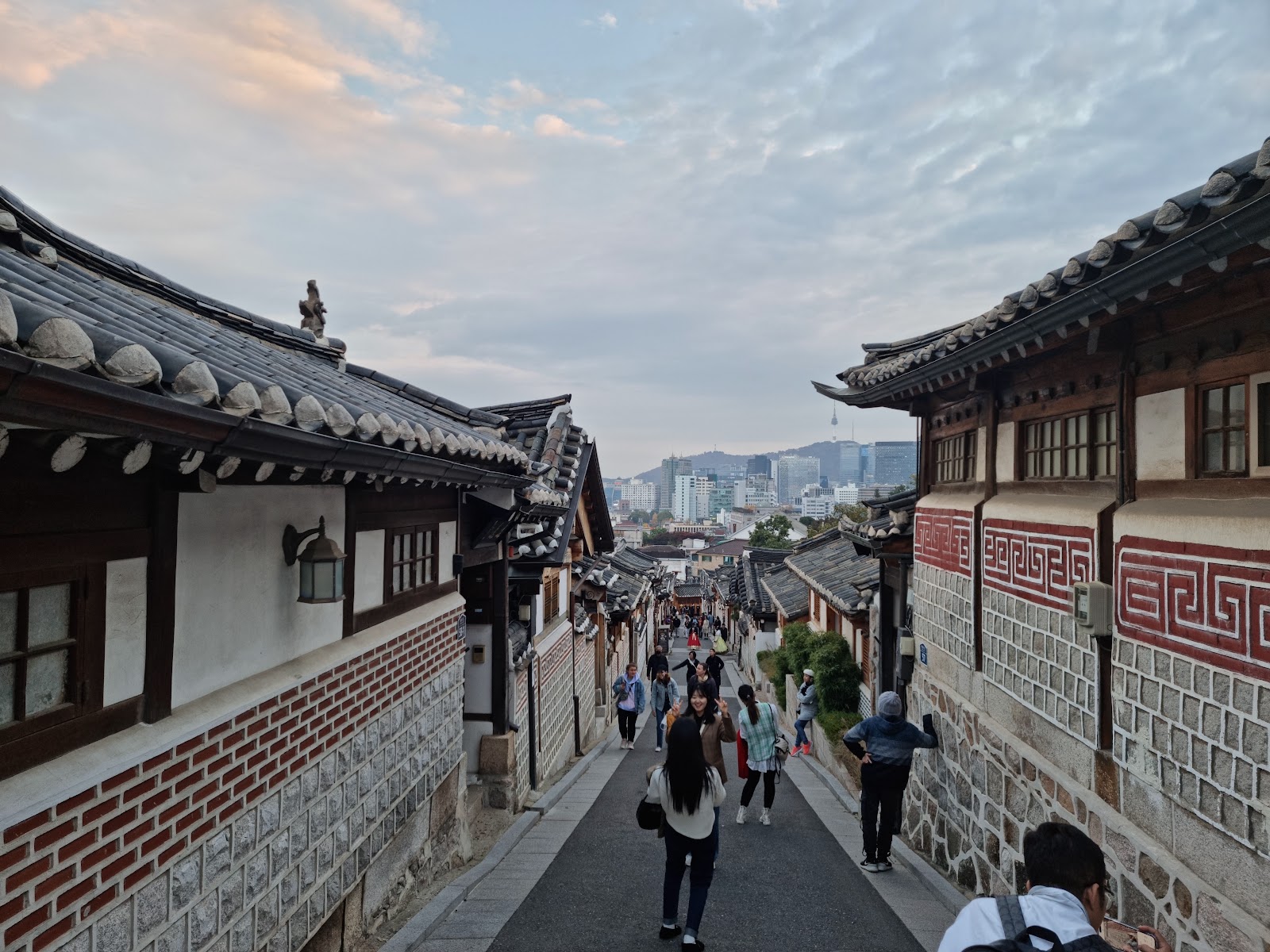
Bukchon means “northern village”. The name comes from where it is: north of Cheonggyecheon Stream and Jongno, two of old Seoul’s main landmarks. The neighbourhood dates back to the Joseon dynasty and still has hundreds of hanok, packed tight along narrow lanes that go up and down.
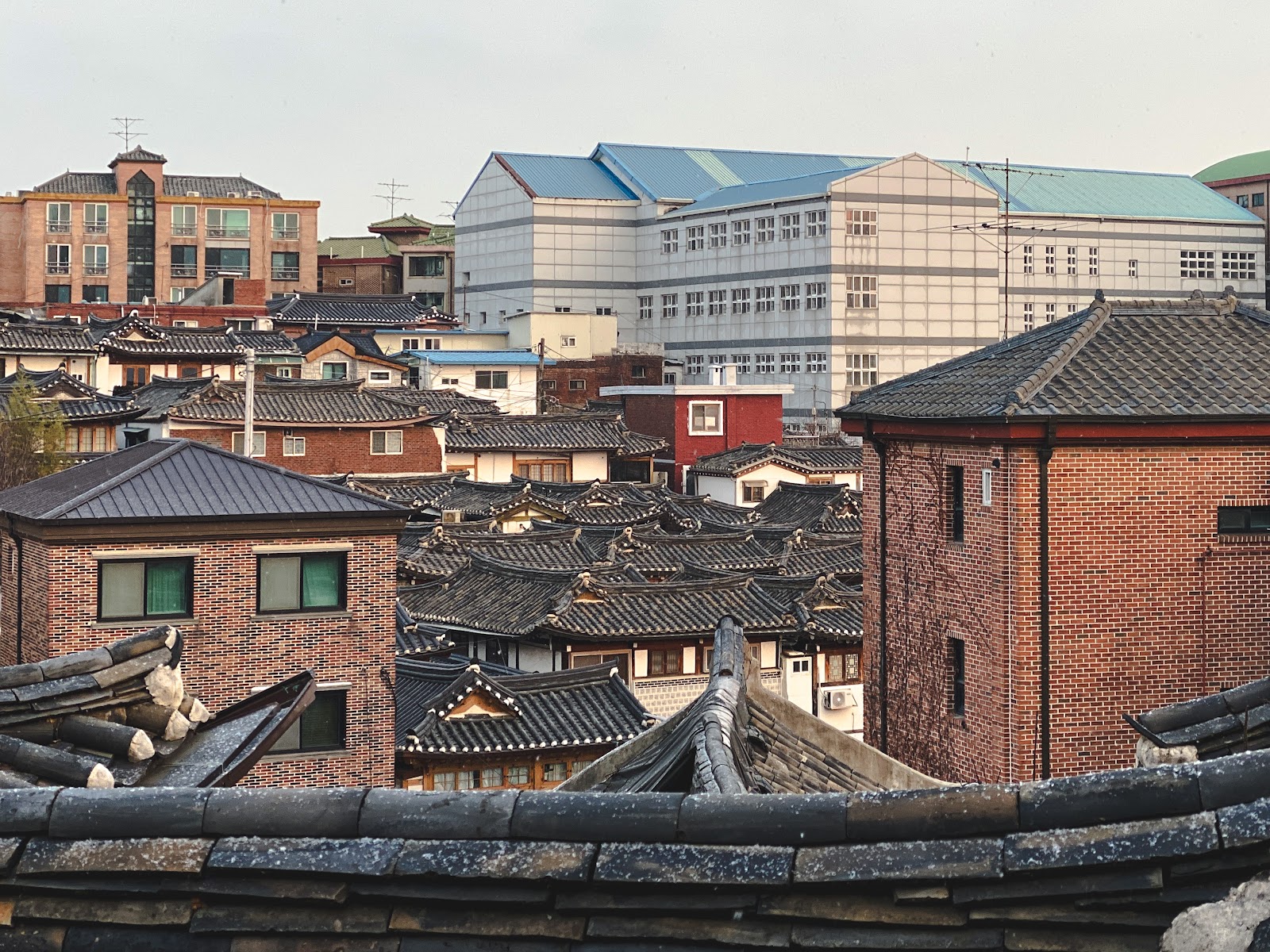
Most of those houses are homes. Quite a few now run as cultural centres, guesthouses, restaurants and tea houses, and those are the ones you can go into (or stay in). You see the rest from the lane: curved tile roofs, wooden gates, and here and there a gap where the towers of downtown Seoul appear behind the eaves.
That gap is half the reason people come. You get an old roofline in front and a modern city right behind it, in the same frame.
🕙 Bukchon Hanok Village Hours: 10:00 to 17:00, on One Road
Google Maps lists the whole village as open 10:00 to 17:00, seven days a week. The Korea Tourism Organization (KTO) listing is more precise: those hours apply to the road along Bukchon-ro 11-gil (북촌로11길). That’s the residential stretch with the famous views, and the rule is aimed at it. If the two sources ever disagree, go with the KTO one, since it names the road.
Before 10:00 and after 17:00, that road is for the people who live on it. That means no sunrise photos on this lane and no staying into the evening. Visitors in the reviews plan around it the same way: arrive after ten, leave by five.
There’s no closing day. The listing says it’s open all year round, so Mondays and public holidays are no different. The shops, cafés and workshops in the village set their own hours, and those aren’t in the official listing.
Two times decide the whole visit: 10:00, when the lane opens to visitors, and 17:00, when it closes. Plan everything else around them.
The no-noise zones
There are no-noise zones all through the neighbourhood. Voices carry in lanes this narrow, and the person on the other side of the wall is at home. Talk at indoor volume and step aside when a resident needs to get past. That’s all it takes.
📋 The Official Details in One Table
| What | Details |
|---|---|
| Admission | Free for every age and nationality. No ticket |
| Visiting hours | 10:00 to 17:00 daily, on the road along Bukchon-ro 11-gil |
| Closing days | None. Open all year round |
| Address (KTO) | 37 Gyedong-gil, Jongno-gu, Seoul |
| Name for map apps | 북촌한옥마을 |
| Parking | None at the village |
| Accessible parking | Changdeokgung car park, Jeongdok Library |
| Phone (KTO listing) | +82-2-2148-4161 |
| Phone (Google Maps) | 02-2133-1371 (from abroad +82-2-2133-1371) |
| Guided walking tour | 3 hours 30 minutes. Book at dobo.visitseoul.net at least 3 days ahead |
| Google Maps rating | 4.4 from 24,687 reviews |
Free means free for everyone: any age, any passport, nothing to buy or show. The only money you spend here is on things you choose, like a coffee, a class or a souvenir.
🚇 Getting There Without a Car
Come by subway or taxi. The village has no parking at all. Most people arrive at Anguk Station on Line 3, which is also where the official walking tour starts and ends. The station has an accessible toilet, which is good to know before you head uphill.
In your map app, search 북촌한옥마을 or the address on the KTO listing, 37 Gyedong-gil. That’s the address of the Bukchon Culture Center, the first stop on the walking tour and a good place to start your own loop. For walking directions in Korea, use Naver Map or Kakao Map.
You can walk from Gyeongbokgung: head east from the palace and the streets start going uphill. If you’re doing both on one day, check the palace’s closing time first in our Gyeongbokgung Palace guide. It changes with the season, and that decides which one you do first.
If you need accessible parking, the official listing has designated bays at the Changdeokgung car park and at Jeongdok Library. The village itself has no parking, so for everyone else the subway is easier.
🗺️ Two Ways to Walk It
On your own, in about an hour
Reviews put it at under an hour to see the lanes at an easy pace. That’s walking and stopping for photos. Add a craft class or a tea stop and plan on two hours.
Walk Bukchon-ro 11-gil first, while you know you’re inside the visiting hours. After that, just wander. The neighbourhood is compact, so a wrong turn costs you a few minutes at most.
The official walking tour: 3 hours 30 minutes
The KTO listing also includes a guided walking course. It takes 3 hours 30 minutes and goes in this order:
- Anguk Station
- Bukchon Culture Center
- Gahoe-dong 11-beonji (beonji is the old lot-number address system)
- Hansangsu Embroidery Workshop
- Gahoe Folk Drawing Shop
- Bukchon Museum “Old Fragrance”
- The Yun Bo-seon House in Anguk-dong, home of a former president
- Back to Anguk Station
You book online at dobo.visitseoul.net, in Korean, English, Japanese or Chinese. Book at least three days before the day you want, so the morning of is too late. The listing doesn’t mention a fee for the tour, so check on the booking page.
Walking the same loop yourself
You can also walk that route on your own, and it starts and ends at the same station. The workshops and the museum keep their own hours, though, and the listing doesn’t say what they are or whether they charge. If you find them open, go in.
🎨 How to Get Inside a Hanok
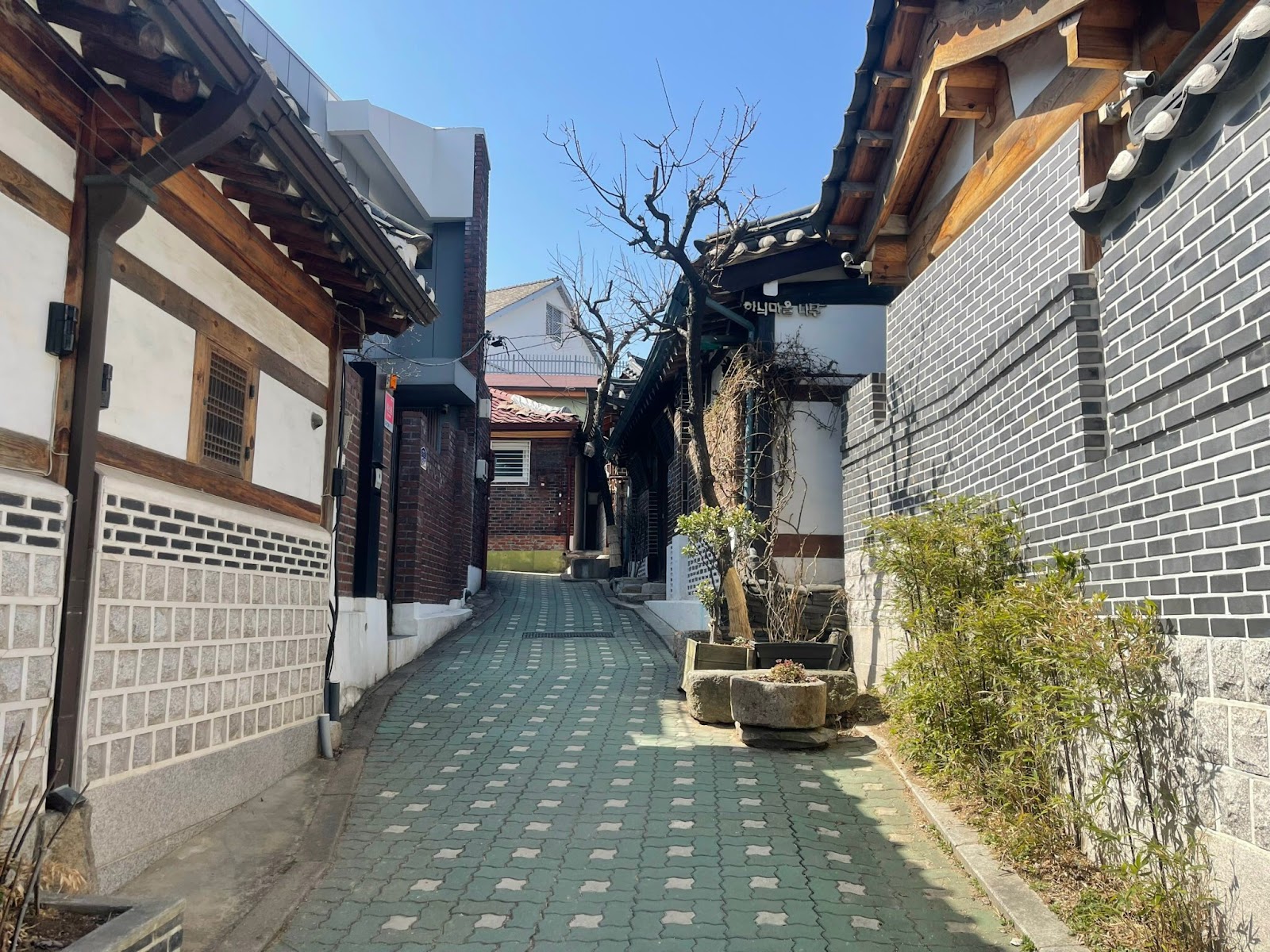
Along the lanes you’ll pass places offering short traditional craft classes, like painting a ceramic piece or making a small handmade gift. They take 50 minutes to an hour. One visitor who took a class said it was cheap. The official listing gives no prices, so ask at the door.
A class is also the easiest way to spend a full hour inside a hanok.
Tea houses and restaurants get you inside with less commitment. The KTO lists them among the hanok that now run as businesses, along with guesthouses and cultural centres. Order a drink and you get to sit inside a hanok.
The walking-tour stops are a third option: an embroidery workshop, a folk-painting studio and a museum, all in the neighbourhood.
The souvenir shops and cafés along the way are pretty, and their prices reflect it. A takeaway coffee for your walk round the lanes is the cheap compromise.
📸 Hanbok, Photos and Summer Heat
If you’ve rented a hanbok, this is the place to use it. The narrow lanes and tiled roofs make good backgrounds without much effort. Stand at the edge of the lane when you shoot so residents can get past.
Summer is the hardest season. It gets very hot up here, and the lanes are uphill, which feels steeper in July. Bring a hat or a small umbrella, and water. If you can, do the walking at 10:00 and keep the indoor stops for the hottest part of the afternoon.
♿ Wheelchairs, Strollers and Accessible Toilets
This section comes from the KTO’s barrier-free travel data for Bukchon, which is published in Korean. It’s written for wheelchair users, and parents with strollers will need the same information.
- Routes: the main routes are listed as wheelchair accessible. The lanes still slope, so expect some pushing uphill.
- Wheelchair loan: available at the local community service centre. The listing spells it 가을동, which looks like a typo for 가회동 (Gahoe-dong), the centre it also lists for accessible toilets. Ask for 가회동 주민센터.
- Accessible toilets: Anguk Station, Jeongdok Library and the Gahoe-dong Community Service Centre.
- Accessible parking: designated bays at the Changdeokgung car park and Jeongdok Library.
- Blind and low-vision visitors: a guide who gives spoken commentary can be arranged if you reserve ahead.
- Deaf and hard-of-hearing visitors: a dedicated guide can also be arranged with a reservation.
For both guide services, the number of guides available varies by day of the week, so give an exact date when you ask. The inquiry number on the KTO listing, +82-2-2148-4161, is a good first call.
For parents, the listing says nothing about stroller rental, nursing rooms or baby-changing tables. Plan your breaks around the three accessible toilets above, and expect the same slopes a wheelchair would face.
⏱️ A Half Day That Fits the Hours
Here’s one way to fit Bukchon and the palace into the same day.
- 10:00 Bukchon-ro 11-gil, as the lane opens to visitors.
- 11:00 A craft class or a tea house. Allow 50 to 60 minutes.
- 12:00 Lunch, then walk west toward Gyeongbokgung.
- Afternoon The palace, timed around its seasonal closing hour.
Want to do the palace first? That works too. Just get to Bukchon-ro 11-gil at least an hour before 17:00, which is enough time for the lane.
Once the lane closes at 17:00, you have the evening free. Our Gwangjang Market guide covers the food stalls that stay open after dark. If you want more hanok after Bukchon, with more cafés in them, Ikseon-dong is a smaller hanok neighbourhood just south-east of Anguk Station.
❓ Short Answers
Is Bukchon Hanok Village free?
Yes. There’s no admission fee and no ticket, whatever your age or nationality.
What are the opening hours?
Visitors can walk the road along Bukchon-ro 11-gil from 10:00 to 17:00, every day. Shops and cafés set their own hours.
Is it closed on Mondays or public holidays?
No. The official listing says it’s open all year round.
How much time do I need?
Under an hour for the lanes on your own, or about two with a class or a tea stop. The official walking tour takes 3 hours 30 minutes.
Do I need to book?
Not for the village. The guided walking tour is booked online at dobo.visitseoul.net, at least three days ahead.
Is there parking?
Not at the village. The official listing has accessible bays at the Changdeokgung car park and Jeongdok Library.
Can I go with a wheelchair or a stroller?
Yes, with some effort. The main routes are listed as wheelchair accessible, but the lanes slope. Accessible toilets are at Anguk Station, Jeongdok Library and the Gahoe-dong Community Service Centre.
📝 The Whole Visit in Seven Lines
- Free for everyone, no ticket, open every day of the year.
- Bukchon-ro 11-gil is open to visitors from 10:00 to 17:00 only.
- Most houses are homes, and there are no-noise zones all through the neighbourhood.
- Under an hour on your own. The official tour takes 3 hours 30 minutes; book at least 3 days ahead.
- No parking at the village. Take Line 3 to Anguk Station.
- Accessible toilets: Anguk Station, Jeongdok Library, Gahoe-dong Community Service Centre.
- Summer is hot and the lanes go uphill, so bring a hat or an umbrella.