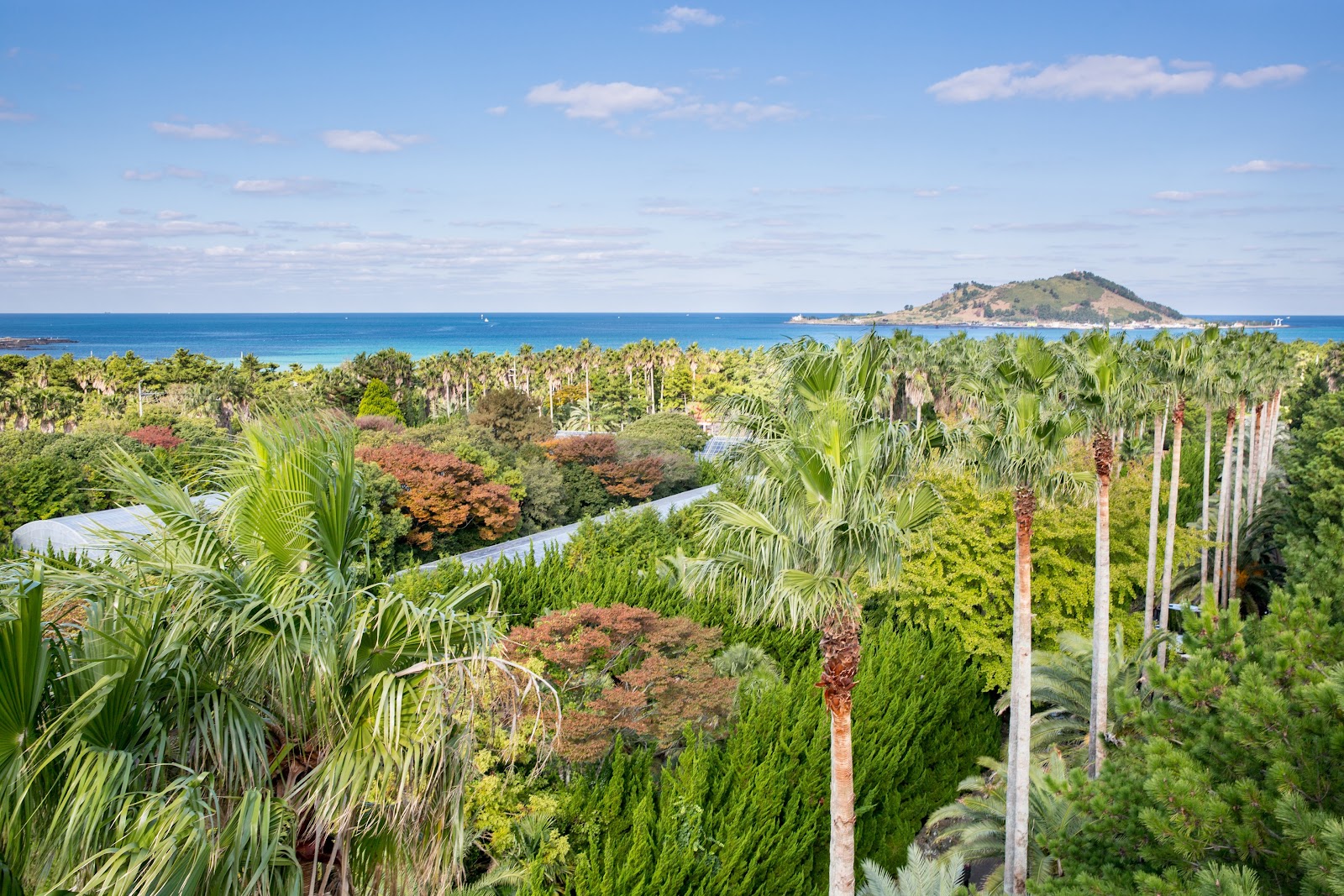
Hallim Park gives you a subtropical garden, two lava caves and a folk village for one ticket. It’s on Jeju’s west coast in Hallim-eup, about 33 km west of Jeju City. The garden covers close to 100,000 square meters (about 25 acres) and faces Hyeopjae and Geumneung beaches, with Biyangdo Island offshore.
An adult ticket is 15,000 won, roughly US$10 to 11. That gets you the two caves, Hyeopjaegul and Ssangyonggul, plus a palm avenue, flower gardens and peacocks walking around loose. It works well for a group that can’t agree on anything else.
It has 4.4 stars from 6,231 Google reviews. One group of reviewers didn’t plan to stay long and spent four hours there, so give it half a day.
Two things before you go. For nine months of the year, the closing time on Google doesn’t match the official schedule. And if seeing animals in pens upsets you, read the animal section below before you buy a ticket.
🌴 Hallim Park Jeju: what one ticket covers
The Korea Tourism Organization (KTO) says the park was started in early 1971 on barren land. Tons of soil were brought in first, and the subtropical plants were planted in that. The palms on Palm Tree Road were planted that year, so they’re 55 years old now.
Here’s what’s on the grounds:
- Palm Tree Road, lined with the 1971 palms
- Subtropical Botanic Garden
- Jeju Stone and Bonsai Garden
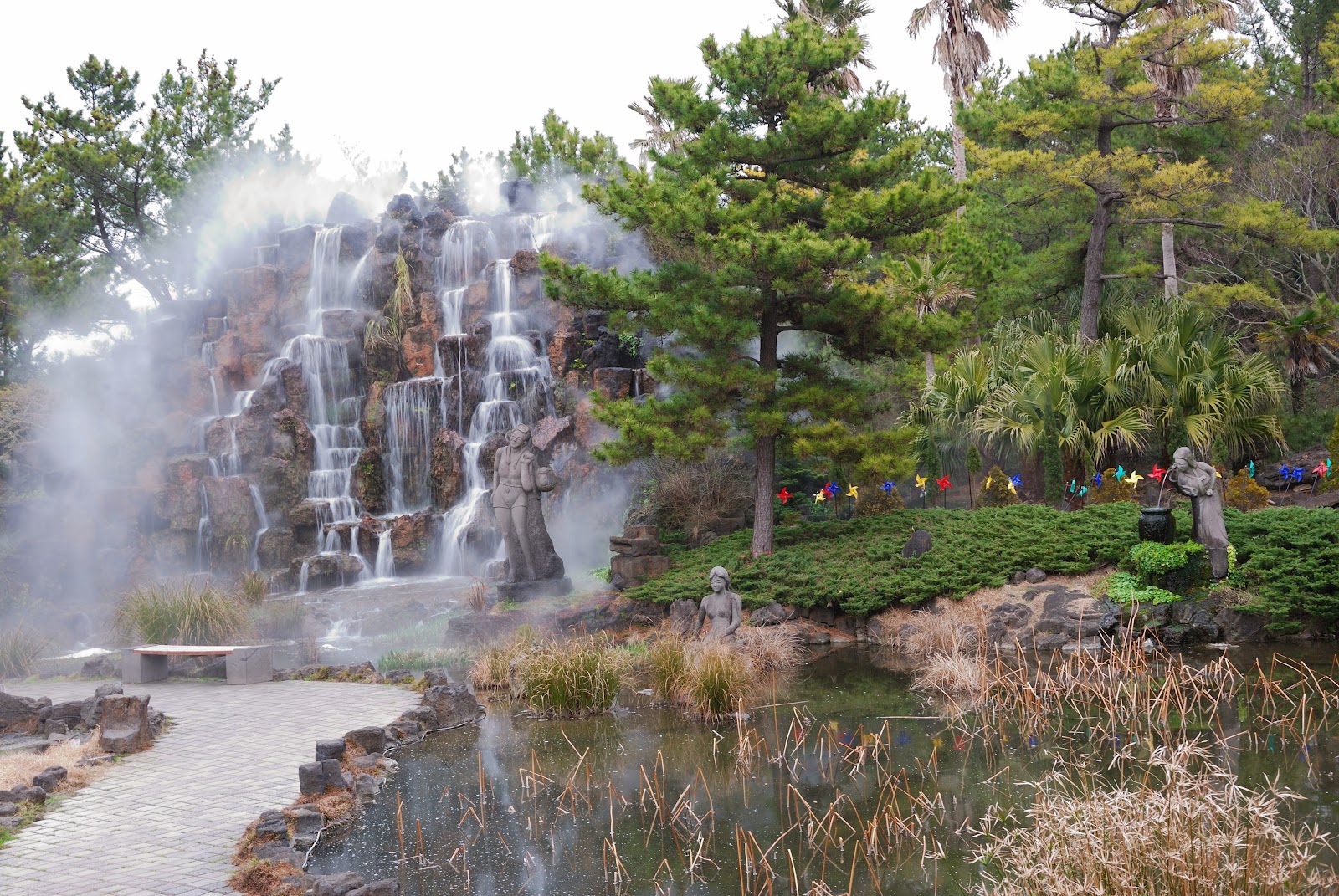
- Water Garden
- Hyeopjaegul and Ssangyonggul, the two caves
- A folk village
- Birds and animal pens: peacocks (one of them white), ostriches and tortoises
- A children’s amusement area and outdoor spaces to rest
The gardens
KTO says the gardens are planned so there’s something to see in every season. A visitor who came in May found the park well kept and uncrowded, with lots of flowers and something to look at in every section. That’s about the best review a garden can get.
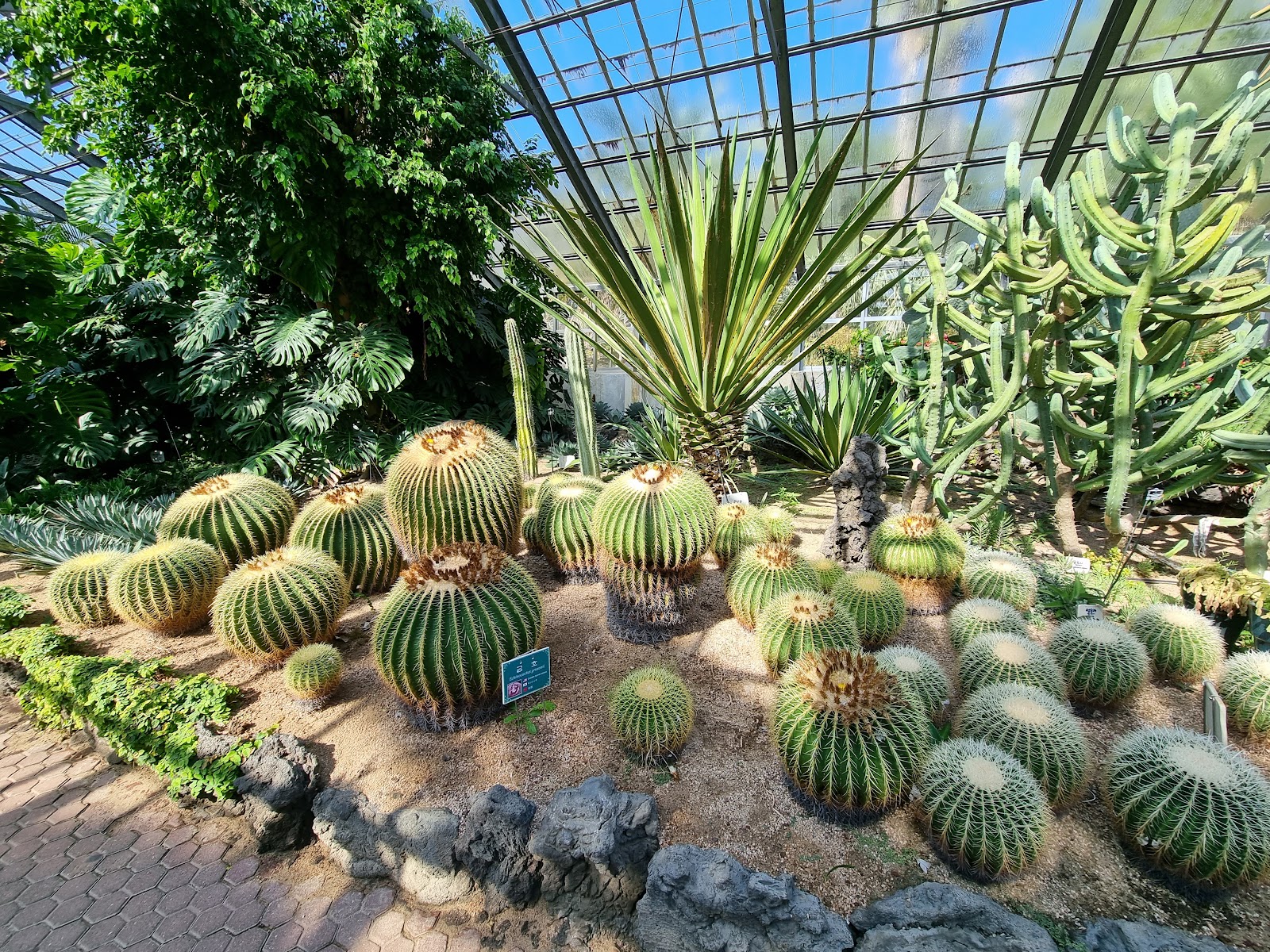
Some of the gardens are indoors. One reviewer called Hallim one of the larger botanic gardens on Jeju, with an arboretum both inside and outside. That helps on a hot or wet afternoon.
Stone has its own section too, the Jeju Stone and Bonsai Garden. One reviewer named the stonework, along with the plants and the animals, as what made the visit good.
Some parts are shaded and some aren’t. There’s plenty of shade under the trees and plenty of open sun between them. Two reviewers said it’s a good place for photos.
The caves: Hyeopjaegul and Ssangyonggul
A little Korean first. Gul means cave, so “Hyeopjaegul Cave” says cave twice. Hyeopjae is also the name of the beach the park faces, and ssangyong means twin dragons.
These two caves are what the park is officially known for. KTO’s listing calls them the only “two-dimensional” caves in the world, which is a stiff translation. The Korean term means dual. They are lava tubes that also have the features of a limestone cave.
So the caves are mostly interesting for their geology. One reviewer who liked the rest of the park found the caves interesting but small-scale, and thought a geologist would get the most out of them. Keep that in mind before you go in.
If someone in your group uses a wheelchair: KTO’s accessibility data covers parking, the entrance and the toilets, but says nothing about the caves. Ask at the ticket desk before you plan to go through them.
The folk village, the birds and the animal pens
Besides the gardens and caves, the park has a folk village, a children’s amusement area and outdoor spaces to rest. That’s why the official listing says the park suits kids and adults alike.
Peacocks walk around freely. The bird area also has a white peacock next to the usual blue-green ones, and there are ostriches behind a fence. One visitor thought the ostriches looked ready to make a run for it.
This is also the part that left at least one visitor unhappy. They came for the gardens and found tortoises in small, bare pens with concrete floors and no soil to dig in. They also felt the ostrich pen was far too small for the bird. If that would spoil your day, now you know it’s there.
🤔 Who should skip it
- People hoping for big, dramatic caves. These two are interesting but small-scale.
- Anyone who finds caged animals hard to watch. The pens are inside the park.
- Anyone arriving after 15:00 between November and February. The park closes at 16:30, so you’d have to rush everything.
If you want old forest, remember that every tree here was planted in 1971 or later. For trees that are centuries old, go to Bijarim Forest on the east side of the island.
Mixed groups do well here. The kids get peacocks and the amusement area while the adults walk the gardens, and nobody has to argue about where to go next.
⏰ Opening hours: three closing times, one opening time
Google Maps shows 09:00 to 18:00, seven days a week. KTO’s Korean-language listing, which we checked for this article in October 2026, has seasonal hours. The two only agree in summer.
| Months | Official hours (KTO) | Google Maps |
|---|---|---|
| March–May | 09:00–17:30 | 09:00–18:00 |
| June–August | 09:00–18:00 | 09:00–18:00 |
| September–October | 09:00–17:30 | 09:00–18:00 |
| November–February | 09:00–16:30 | 09:00–18:00 |
We go by the official hours. If you trust Google in December, you’ll be planning for an hour and a half after the park has closed.
There are no closing days. The park is open every day of the year.
Neither source gives a last entry time. If you’re arriving late in the day, call 064-796-0001 before you set off.
Want the full four hours? Be inside by 12:30 from November to February, by 13:30 from March to May and in September and October, and by 14:00 from June to August.
🎟️ Tickets: who counts as a teen, a child or a senior
These prices are from the KTO listing. The age groups follow Korean school levels, so check them before you pay.
| Ticket | Who it covers | Individual | Group (20+) |
|---|---|---|---|
| Adult | Standard rate | 15,000 won | 12,000 won |
| Teenager | Middle and high school students (grades 7–12) | 10,000 won | 8,000 won |
| Child | Age 3 through elementary school (grade 6) | 9,000 won | 7,000 won |
| Senior | Age 65 and older | 12,000 won | 11,000 won |
In rough dollar terms, an adult ticket is US$10 to 11 and a child’s is US$6 to 7. Two adults with a 15-year-old and an 8-year-old pay 49,000 won, around US$35.
A 19-year-old at university has finished high school, so they pay the full 15,000.
The list leaves two things out. It shows no separate price for foreign visitors, and it has no price for children under 3 (the children’s rate starts at age 3). If you’re bringing a toddler, ask at the ticket desk.
Seniors aged 65 and over pay 12,000 won. That’s 3,000 won off, and the list shows no free entry for them. The group rate starts at 20 people, so it mostly matters if you’re on a tour.
🚌 Getting there: bus 202 or the parking lot
The address is 300 Hallim-ro, Hallim-eup, Jeju-si. In map apps and with taxi drivers, use the Korean name (한림공원). The bus stop has the same name.
By bus, take route 202 to the Hallim Park stop. KTO’s accessibility data says low-floor buses run on route 202, which helps if you have a stroller or a wheelchair. Check live bus times in Naver Map or Kakao Map before you leave.
You can also drive. The official listing says there’s parking but doesn’t give a fee or the number of spaces, so we won’t guess. There are 8 accessible spaces in the Hallim Park parking lot, about 230 m from the park.
Phone: 064-796-0001, or +82-64-796-0001 from a foreign number.
♿ Wheelchairs, strollers and toilets
This section comes from KTO’s accessible travel data, which is only published in Korean. It’s written for wheelchair users, but it also answers most of what parents with small children ask.
- Accessible parking: 8 spaces in the Hallim Park parking lot, with extra room around them for getting a wheelchair in and out. From there it’s about 230 m to the park.
- Bus: low-floor buses run on route 202, which stops at Hallim Park.
- Main entrance: a wide entrance with swing doors. The way in has steps and a ramp, and the listing says it’s easy to enter in a wheelchair or mobility scooter.
- Wheelchair rental: available.
- Stroller rental: available for a fee, for children up to 24 months old.
- Accessible toilet: in the park’s public toilets.
What the data doesn’t cover: where the rental counter is, nursing rooms, baby-changing tables, and whether the caves can be reached without steps. Pack a changing mat and ask at the ticket desk about the rest.
🕘 Planning the visit: half a day, caves first
The simple plan: go in at 09:00, leave around 13:00, have lunch, then go to the beach. It works in every season, including the short winter days.
Short on time? See the caves first. They’re the part the official listing highlights, and you won’t see anything like them in other gardens on your trip.
We don’t know much about crowds, but what we know is good. One reviewer went on a Saturday and found it fairly quiet, and another came in May and found no crowds at all. That’s only two visits, so treat it as a hint.
From June to August, bring water and a hat, since a lot of the walk is in full sun. One reviewer also liked the souvenirs, if you still have gifts to buy.
🏖️ Around the park: the beach, the market, the airport
The park faces Hyeopjae and Geumneung beaches, with Biyangdo Island offshore, so the beach is the obvious next stop. In summer, when the park is open until 18:00, you can do it the other way round: beach in the morning, gardens after lunch.
Starting from Jeju City on a date that ends in 2 or 7? Spend the morning at the Jeju Five-Day Market, then drive 33 km west and spend the afternoon at the park. This plan works best from June to August, when the park closes at 18:00.
Heading back toward the airport afterwards? Yongduam Rock on Jeju City’s coast only needs about twenty minutes, so it’s an easy last stop before a flight.
❓ Short answers
How much is Hallim Park?
15,000 won for adults, 10,000 for middle and high school students, 9,000 for children from age 3 through elementary school, and 12,000 for anyone 65 or older. Groups of 20 or more pay less.
What time does Hallim Park close?
It opens at 09:00 every day. It closes at 16:30 from November to February, 17:30 from March to May and in September and October, and 18:00 from June to August. Google shows 18:00 all year, so go by the official times.
Is it closed on any day of the week?
No. KTO lists it as open all year round, with no closing days.
Do foreign visitors get a discount or free entry?
The official price list has no separate price for foreigners. Everyone pays by age group, using the same table.
How long should I plan for?
Half a day. One group of reviewers who didn’t plan to stay long spent four hours.
Can I get there by bus?
Yes. Route 202 stops at Hallim Park, and low-floor buses run on that route.
Can I rent a stroller or a wheelchair?
Yes, both. Strollers cost extra and are for children up to 24 months. There’s an accessible toilet in the park’s public toilets.
Is it worth going on a rainy day?
Partly. The caves and the indoor arboretum keep you out of the rain, but most of the park is outdoors.
📝 Summary
- Where: 300 Hallim-ro, Hallim-eup, about 33 km west of Jeju City, facing Hyeopjae and Geumneung beaches.
- What: close to 100,000 square meters of gardens started in 1971, two lava caves, a folk village and peacocks walking around freely.
- Hours (official): opens 09:00. Closes 16:30 Nov–Feb, 17:30 Mar–May and Sep–Oct, 18:00 Jun–Aug. Open every day.
- Tickets: 15,000 won adults, 10,000 teens, 9,000 children (from age 3), 12,000 seniors (65+). No separate price for foreigners.
- Getting there: bus 202 to the Hallim Park stop, or drive. 8 accessible parking spaces, about 230 m from the park.
- With kids or a wheelchair: paid stroller rental for up to 24 months, wheelchair rental, a ramp at the entrance, and an accessible toilet in the public toilets.
- Time needed: half a day. See the caves first if you’re short on time.
- Worth knowing: the caves are small-scale, and the animal pens have upset at least one visitor.
- Phone: 064-796-0001.