Seogwipo Maeil Olle Market is the covered market in the middle of downtown Seogwipo, on Jeju’s south coast. It’s open from 7 AM to 9 PM, seven days a week. Entry is free and you don’t need to book. Inside, Jeju black pork, live fish, local citrus and peanut ice cream are all within one short walk.
Why spend part of a short trip here? It’s the easiest place in Seogwipo to try several Jeju specialties in one go, sit down while you eat them, and stay dry if the weather turns.
It’s also Seogwipo’s oldest and biggest traditional market. It dates back to the 1960s, it has more than 200 shops, and the people who live here still do their shopping in it.
The catch is that it’s a tourist stop now, too. A lot of the souvenir shops sell much the same stuff, and some of the citrus and pre-packed sashimi is priced for people who won’t be back next week. Avoiding that costs nothing. Walk one full lap before you buy anything.
🧭 Seogwipo Maeil Olle Market at a glance
| Item | Details |
|---|---|
| Hours | 7:00 AM to 9:00 PM |
| Days | Every day, Monday to Sunday |
| Booking | Not needed |
| Entry | Free |
| Address | 18 Jungang-ro 62beon-gil, Seogwipo, Jeju-do |
| Name to search in map apps | 서귀포매일올레시장 |
| Phone | 064-762-1949 |
| Google rating | 4.1 from 29,399 reviews |
Those are the market’s hours. Each stall has its own owner, so a few may open after 7 or close before 9.
No closing day is listed. Over Seollal (Lunar New Year) and Chuseok, though, a lot of stalls at Korean traditional markets close while their owners take the holiday. If your trip falls on either, ask your hotel to call the number above before you plan a meal around it.
🎯 Who it suits, and who can skip it
Worth your time if:
- You’re sleeping in Seogwipo and want dinner without booking anything.
- You’d like to try several Jeju foods without sitting through a full restaurant meal for each one.
- You’re travelling with people who can’t agree on one restaurant. Here everyone picks their own stall.
- You like seeing what locals actually buy for their kitchens.
Less important if:
- Souvenirs are all you want. You’ll find similar things at similar prices all over the island.
- You were hoping for a quiet, locals-only market. Parts of this one now cater to visitors.
📜 What the name means
Maeil means “every day.” That word matters on a Korean market sign, because plenty of towns also have five-day markets that only open on fixed dates. You don’t need a calendar for this one.
Olle is Jeju dialect for the narrow lane that runs from the street to a house’s front gate. If the word sounds familiar, it’s the same one in the name of the Jeju Olle walking trails.
🚶 How to do it: two laps
It’s easy to rush this market and easy to overspend in it. Walking it twice solves both.
👀 Lap one: look at everything, buy nothing
Walk the whole thing once with your wallet put away. Note where the citrus stalls are, which fish counters have the fullest tanks, and which food stalls have people waiting. The same fruit can cost more at one stall than at the next, and you can only find that out by looking at a few.
🍽️ Lap two: eat first, carry last
Eat on the second lap, while your hands are still free. Leave anything you’re taking away until the very end.
Buy the fruit last. If you buy it first, you’ll spend the rest of the visit hauling a bag of tangerines through the fish section.
🪑 Where to sit
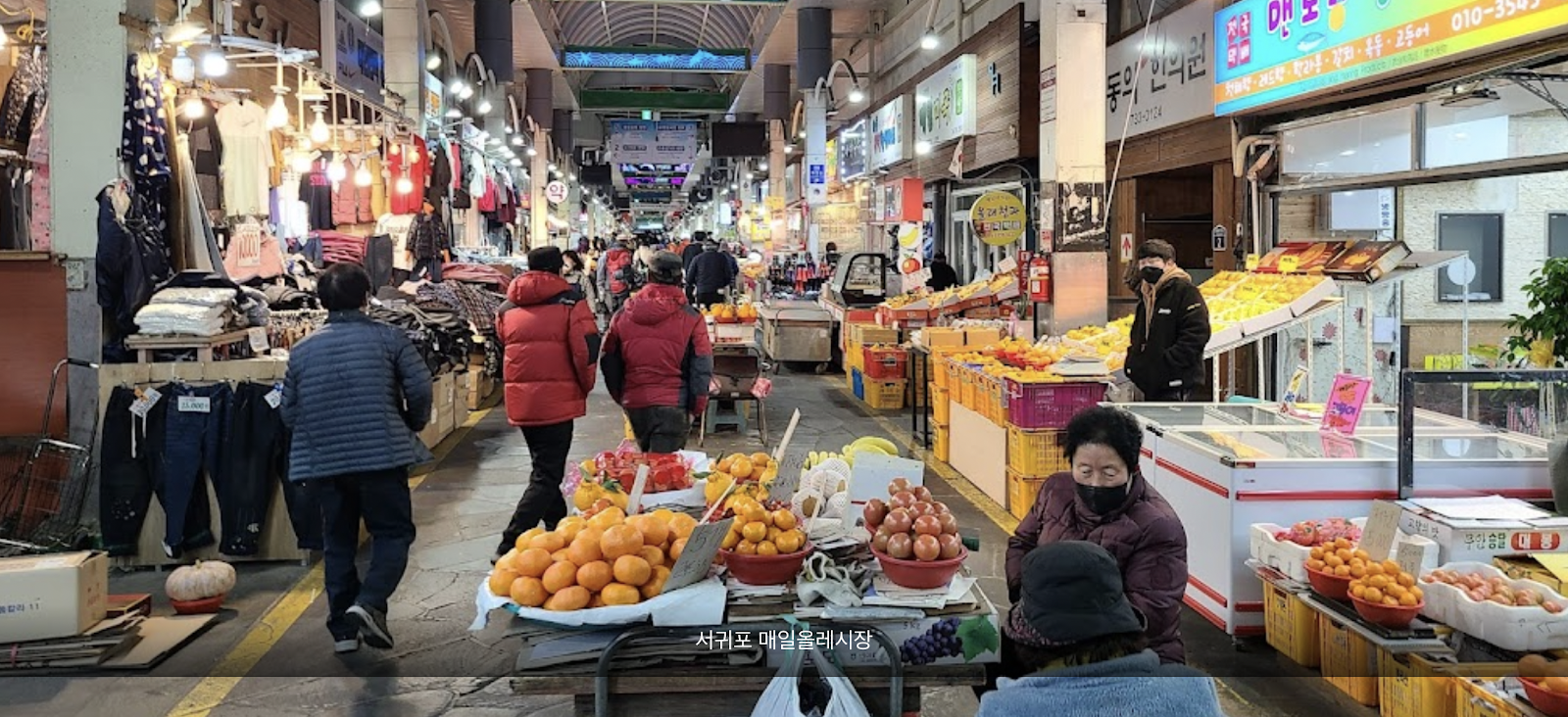
The seats run down the middle of the central aisle, along the raised edge of what looks like an old water channel. People carry their food there from the stalls, and you’ll probably eat yours there too.
No space? Take it back to your room.
🍊 Citrus: compare before you buy
Citrus is Jeju’s crop, and the market is full of it. Small tangerines, the bigger hallabong with the bump on top when they’re in season, and then tangerine juice, tangerine chocolate, tangerine everything.
Citrus is also where tourist pricing shows most. Some sellers charge clearly more than others, and you can’t tell which ones by looking at a single stall. That’s what lap one was for.
Before you pay:
- Look for a price. If there isn’t one, ask before anything goes in a bag.
- Check what the price covers. A box, a bag and a single fruit are very different numbers.
- If a seller offers you a segment, take it. It’s free, and it helps you compare.
Jeju’s main tangerine harvest runs through the colder months, so the fruit stalls look their best from late autumn into winter.
🧳 Getting citrus home
Packing fruit for a domestic flight is normal. If you’re flying on to Seoul or Busan, buy as much as you like.
International flights are a different matter. Plenty of countries stop fresh fruit at the border, so check your own country’s rules before you buy a box. Packaged tangerine products are the easier way to take the flavour home.
🐟 Fish, live tanks and mackerel sashimi
The fish counters are where it still feels most like a neighbourhood market. Plenty of the seafood is alive in tanks, and the rest looks properly fresh.
Even if you’re not buying, walk past the tanks slowly. Half the fun of this section is dinner looking back at you.
🍣 Mackerel sashimi
Mackerel sashimi is the dish to know about here. Mackerel spoils quickly once it’s out of the water, so people mostly eat it raw near the sea where it was caught. Jeju is one of the places Koreans go for it.
Here you’ll see it in ready-packed trays. They’re convenient. They’re also where you’re most likely to pay the tourist price, so compare a few counters before you pick one.
Raw fish shouldn’t spend long in a warm bag. Make it the last thing you buy, and eat it soon after.
🔪 If your room has a kitchen
This is where to buy fish to cook, and the produce stalls sell local vegetables to go with it. At Korean fish counters it’s normal to ask the seller to clean and cut your fish, so ask.
🍢 What to eat while you walk
The market is best known for its ready-to-eat stalls. Share everything: buy one portion for two people, then move on. That way you fit in more stalls.
🐷 Black pork
Black pork is Jeju’s best-known meat, and the food stalls here sell it. If a full barbecue dinner isn’t on your list this trip, this is an easy way to try it.
🍦 Peanut ice cream
Peanut ice cream is a Jeju thing, thanks to the peanuts grown on Udo, the small island off the east coast. The market sells it too. Save it for the end.
🥟 Everything else
The rest is the usual Korean market street food, the same kind you’d find in markets across the country. It’s good, and it fills you up. If you only have room for a few things, make them the Jeju ones.
A simple plan for two people:
- One black pork dish from the food stalls, shared
- One tray of mackerel sashimi, chosen after comparing a few
- Something citrus to drink or snack on as you walk
- One peanut ice cream each, because nobody shares those
🎁 Souvenirs, and the shops locals use
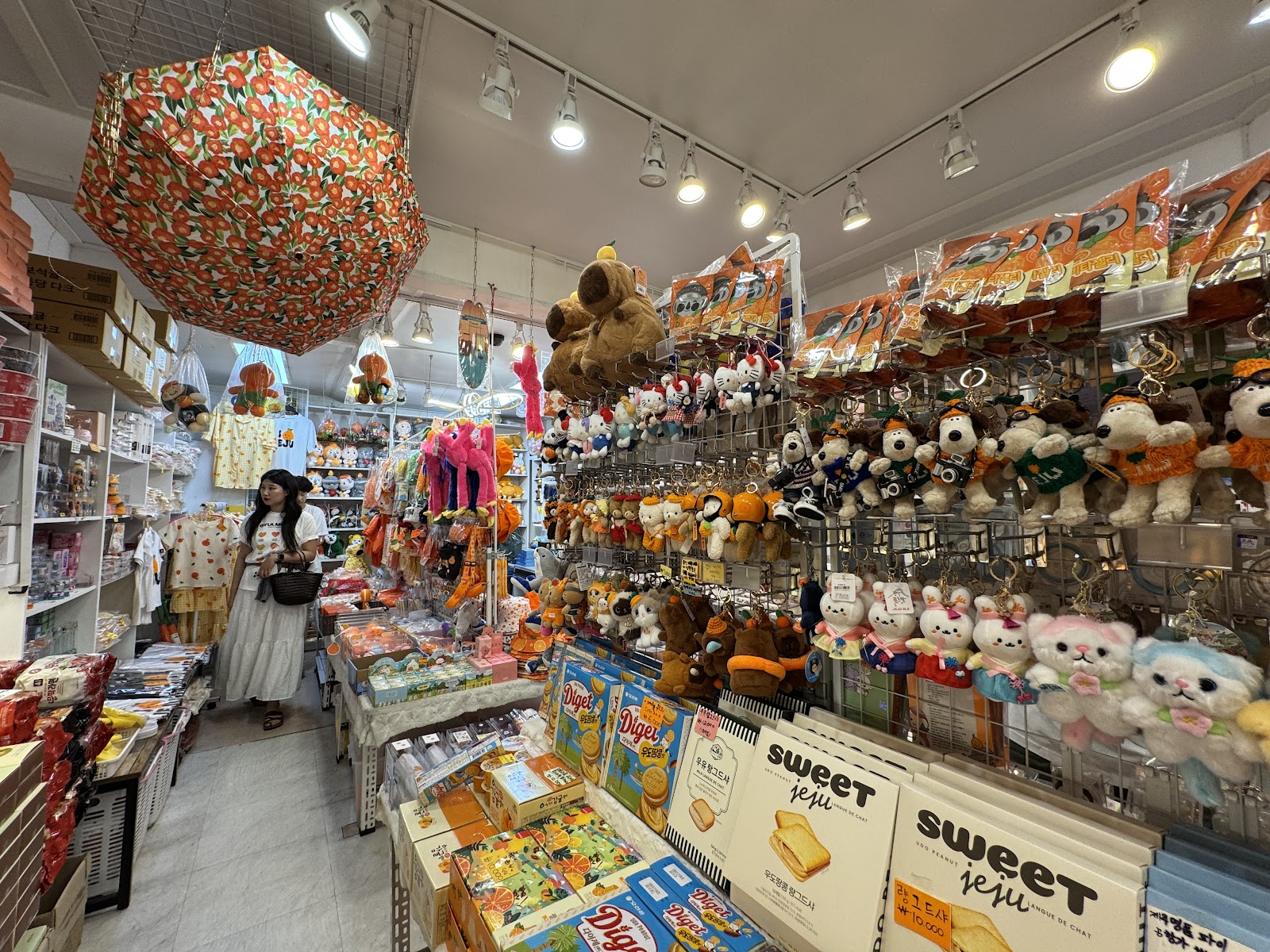
There are a lot of souvenir shops, and after a few they start to look alike. Their prices are usually about the same as elsewhere on Jeju, though, so there’s no point waiting for a cheaper shop later. If you like something, buy it.
Tangerine products are the easiest souvenir to get home. They’re packaged, and they survive a suitcase.
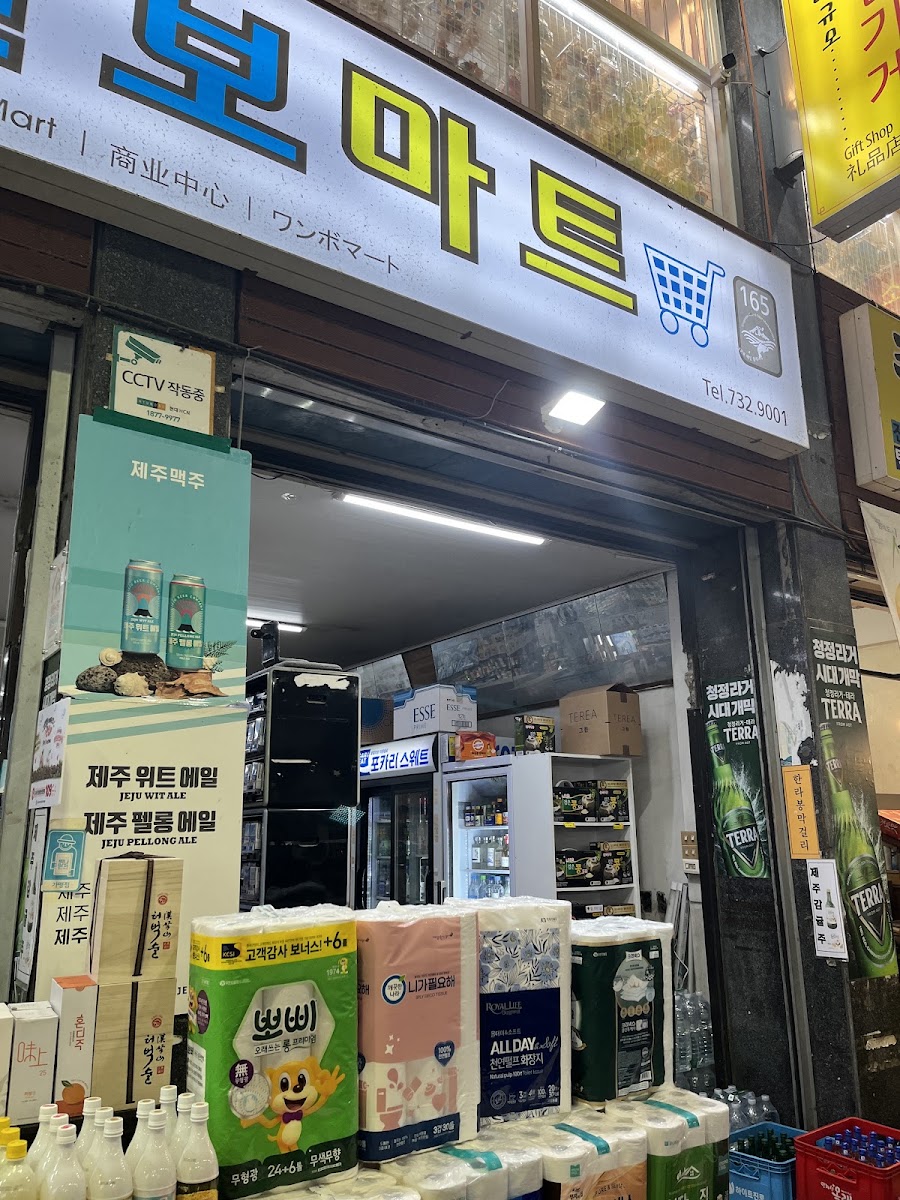
There are also shops selling household goods. Nobody flies to Jeju for those, which is why they’re worth a quick look. This part of the market is still run for the people who live here.
🕖 When to go
🌅 First thing
It opens at 7 AM, so it works as a first stop before a day out, for fruit and snacks for the road. Some food stalls may not be open yet that early.
🌆 Dinner
It closes at 9 PM, so it works just as well at the end of the day. Graze through a few stalls, sit down in the central aisle, and carry the rest back to your room.
Spending the day inland? The gate at the Saryeoni Forest Trail closes at five. The market stays open for another four hours after that.
🌧️ Bad weather
Jeju weather changes fast, and wind or rain can ruin a coastal walk. A market with a roof is the obvious backup, and because it’s open every day, it’s there whenever the forecast lets you down.
🗺️ Getting there
The market is in downtown Seogwipo, on the south coast. Jeju’s airport is in Jeju City on the north side, so coming straight from a flight means crossing the island.
Put the Korean name from the table into Naver Map or Kakao Map. Both show current bus routes and walking directions. Google Maps gives incomplete directions in Korea.
Staying downtown? Check the walking time in the app first, because you may not need a bus at all. For a taxi, Kakao T is the app most Koreans use. You can also just show a driver the Korean name on your screen.
Driving a rental car? Look up parking in Naver Map before you set off, so you’re not circling downtown streets.
Heading back to the airport at the end of your trip? Yongduam Rock is close by and quick to see, so it’s a good way to use spare time before check-in.
💳 Paying and asking prices
Each stall decides what payment it takes. Carry a card and some cash, and you’ll be fine either way.
If something has no price on it, ask before the seller starts bagging it. “Eolmayeyo?” means “How much is it?” If you don’t catch the number, hold out your phone’s calculator and let the seller type it.
Whether the seller speaks English depends on the stall. Pointing and a calculator cover the rest.
❓ Short answers
Is Seogwipo Maeil Olle Market open every day? Yes. It’s open 7 AM to 9 PM, Monday to Sunday. A few stalls keep shorter hours, and many close over Seollal and Chuseok.
Do I need to book or buy a ticket? No. It’s a public market and entry is free.
Is it worth it with only one night in Seogwipo? Yes. It’s the easiest dinner in town, and since it closes at 9 PM you can still have a full day out first.
Has it turned into a tourist trap? In places. A lot of the souvenir shops sell the same things, and some citrus and pre-packed sashimi is priced for visitors. The fish counters, produce stalls and household shops still serve locals.
What should I eat first? The Jeju things: black pork from the food stalls, then mackerel sashimi once you’ve compared trays. Peanut ice cream to finish.
Is it a good rainy-day plan? Yes. It’s covered, and it’s open every day.
Can I take tangerines home? On a domestic flight, yes. For an international flight, check your country’s customs rules first. Packaged tangerine products are the easier buy.
How does it compare with Gwangjang Market in Seoul? It’s smaller, and it’s best for produce, fish and food you carry to a seat. The food section at Gwangjang Market is built around counters where you sit and eat.
📝 Quick recap
- Open 7 AM to 9 PM, every day. Free, no booking.
- It’s covered, so it works when Jeju’s weather turns.
- Walk one full lap before you buy, and compare citrus and pre-packed sashimi in particular.
- Eat the Jeju things first: black pork, mackerel sashimi, citrus, peanut ice cream.
- Sit on the raised edge down the central aisle.
- Souvenir prices are about the same as elsewhere on Jeju. Fresh fruit may not get through customs back home.
- Search the Korean name in Naver Map or Kakao Map.