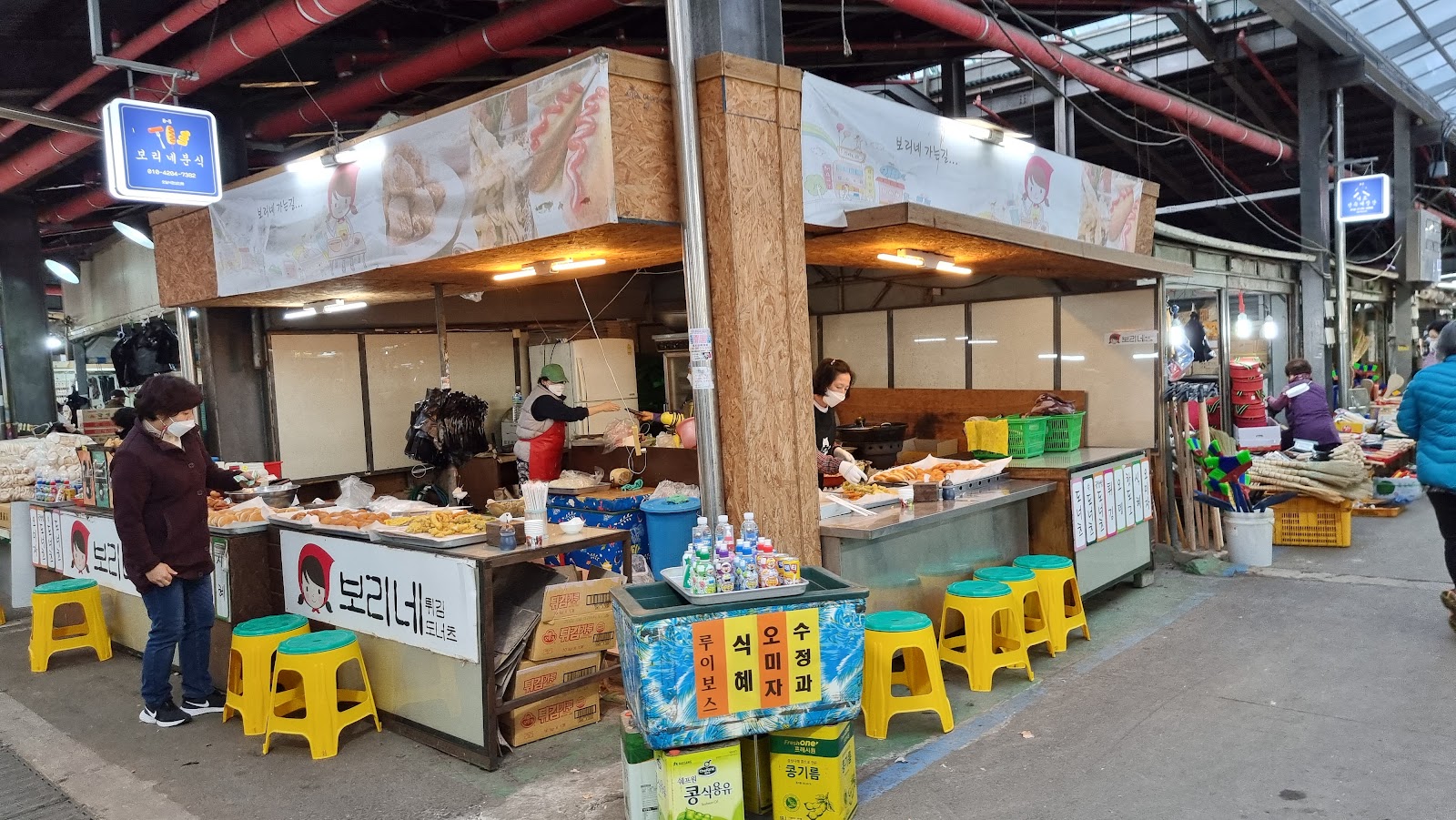
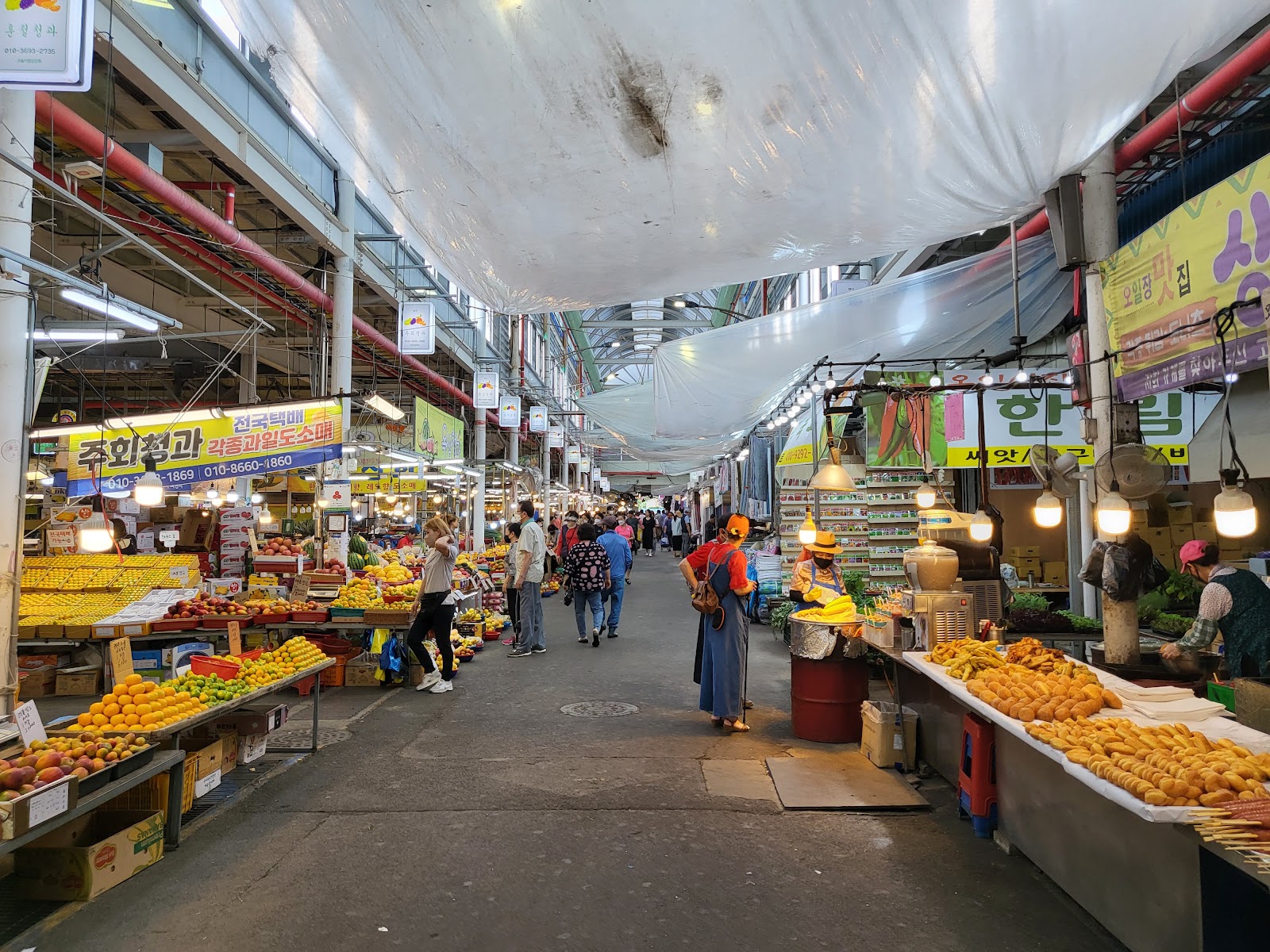
The Jeju Folk Five-Day Market is Jeju City’s big local market. It only runs on dates that end in 2 or 7: the 2nd, 7th, 12th, 17th, 22nd and 27th of every month. On those days the stalls fill with fish, vegetables, fresh ginseng, plants and Jeju oranges, and the hotteok comes straight off the griddle.
It’s also a short ride from Jeju International Airport. If your arrival or departure day is a 2 or a 7, you can stop on the way in or the way out, eat lunch from the stalls, and lose almost nothing from the rest of the trip.
Check the date before you get in a taxi, though. Google Maps lists 7:00 AM to 6:00 PM for every day of the week, which makes it look like a daily market. Those are the hours on a market day. On the dates in between, most of the stalls are shut.
📋 At a Glance
| Name on Google Maps | Jeju Traditional Five-Day Market |
| Market days | Dates ending in 2 or 7: the 2nd, 7th, 12th, 17th, 22nd and 27th |
| Hours | Google lists 7:00 AM to 6:00 PM every day. Go on a market day. |
| Address | 26 Oiljangseo-gil, Jeju City, Jeju-do |
| Phone | 064-743-5985 |
| Google rating | 4.2 from 6,985 reviews |
| Parking | Free |
| Booking | Not needed. Walk in. |
| Best for | Arrival or departure day, a wet day, a market lunch |
📅 When the Jeju Folk Five-Day Market Opens
Oiljang is the Korean word for this kind of market: o is five, il is day, jang is market. The “folk” in the English name comes from minsok. Google Maps lists the market as Jeju Traditional Five-Day Market, so search for that name there.
Korea has run rotating markets like this for centuries, and each one has its own pair of digits. Jeju City’s pair is 2 and 7, which gives you six market days a month.
The name is what confuses people. “Every five days” holds inside a month and breaks at the end of it. After the 27th, the next market is the 2nd. After a 31-day month that’s six days later, and at the end of February it’s only three or four days later.
Look at the last digit of the date. If it’s a 2 or a 7, go.
With a market roughly every five days, a three-day trip gives you about a three-in-five chance of landing on one. Stay five days and you’ll almost always catch one.
Market days for the rest of 2026
Here they are with weekdays, so you can check them against your flights.
| Month | Market days |
|---|---|
| October 2026 | 12 (Mon), 17 (Sat), 22 (Thu), 27 (Tue) |
| November 2026 | 2 (Mon), 7 (Sat), 12 (Thu), 17 (Tue), 22 (Sun), 27 (Fri) |
| December 2026 | 2 (Wed), 7 (Mon), 12 (Sat), 17 (Thu), 22 (Tue), 27 (Sun) |
Five of those fall on a weekend: October 17, November 7 and 22, and December 12 and 27. If you’d like more room in the aisles, a weekday market day is the safer pick.
If a whole day of your trip depends on one date, check it on Visit Jeju, the island’s official tourism site, before you set off.
🧺 What’s Actually for Sale
This is where Jeju people do their everyday shopping, so the mix is practical: fish, vegetables, fruit, poultry, plants and snacks. Most of it is under a roof, and there’s a lot of it.
Fish and seafood
Walk through the seafood section even if you have nowhere to cook. If you spot long, silver, ribbon-shaped fish, that’s galchi (hairtail), a Jeju staple. Reddish fish split open and dried flat is most likely okdom, the tilefish Jeju is known for.
If you’re staying somewhere with a kitchen, this is where to buy dinner.
Fruit and vegetables
Jeju is Korea’s citrus island, and from late autumn into winter you see mandarins everywhere. A bag of oranges is the easiest thing here to buy and eat on the spot.
The vegetable stalls are mainly for people who cook. They’re still worth a slow walk past, because you’ll see greens and roots you can’t name.
Fresh ginseng
Ginseng is sold fresh here, as whole raw roots. If you’ve only had it as tea or seen it in a gift box, take a look. Whether you can take it home depends on your own country’s customs rules, so check before you buy.
Plants and poultry
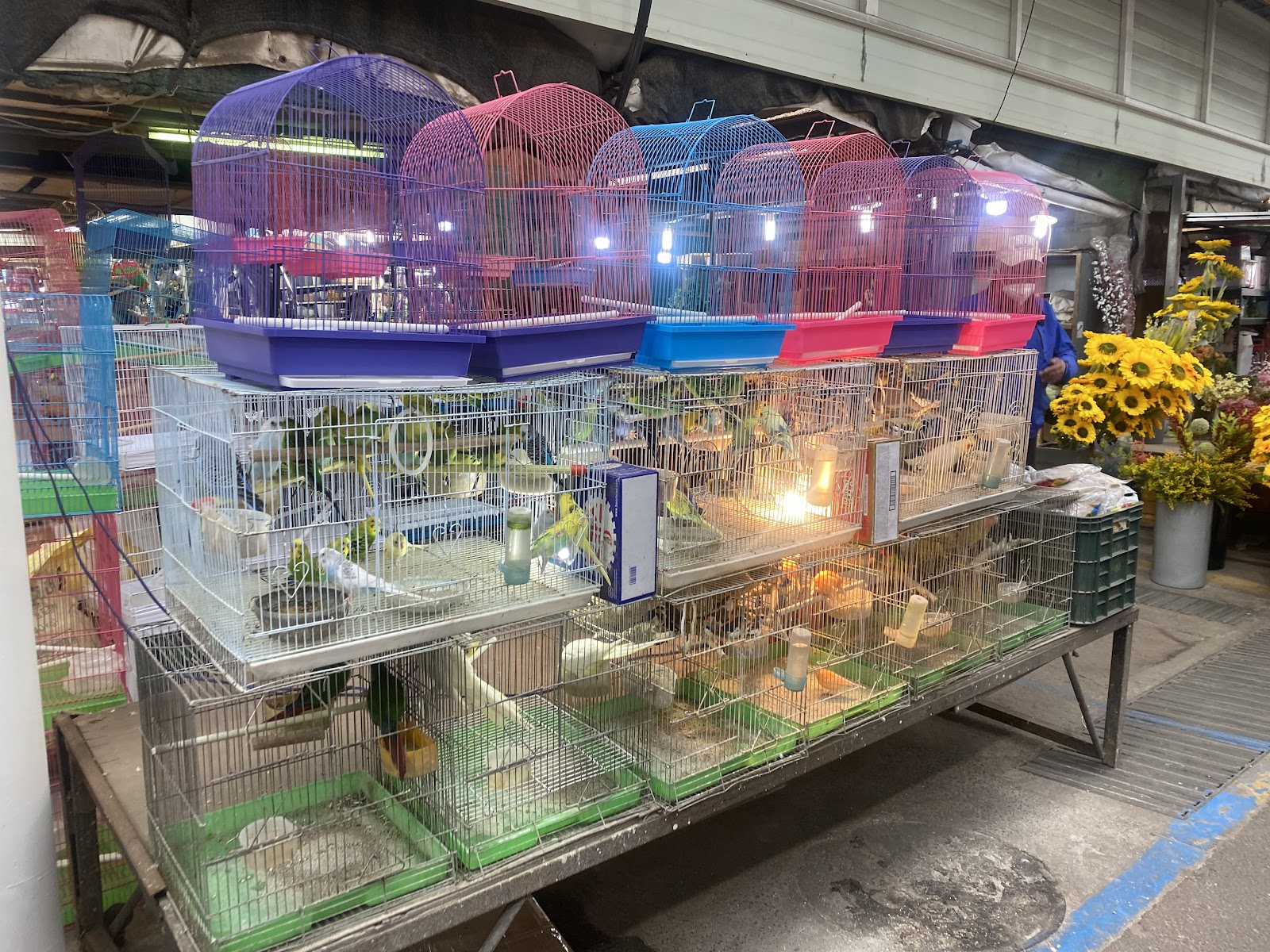
The plant sellers are there for locals with gardens and balconies. They’re nice to walk past, but most visitors can’t buy anything, since few countries let live plants through customs without paperwork. The poultry sellers are there for the same local shoppers.
🥞 What to Eat as You Walk
There’s plenty of food in the market, so you won’t need to plan lunch. These are the four things I’d make room for.
Hotteok
Hotteok is a flat pancake fried on a griddle, with melted brown sugar inside. Here it’s cooked right at the stall. On a cold market morning it’s the best thing you’ll hold all day.
Tear a small hole in the edge and let the steam out first. The sugar inside comes out like lava and heads straight for your chin.
Jeju oranges
Buy a small bag and eat them as you go. Keep a spare plastic bag for the peel, because public trash cans can be surprisingly hard to find in Korea.
Old-style biscuits and pastries
Look for the stalls selling old-fashioned Korean biscuits and pastries. They keep well, so buy some for the flight or for a late night at the hotel.
Drip coffee
You can get drip coffee inside the market, and it’s worth having. Buy one early and carry it on your first lap.
🚗 Getting There
The address is 26 Oiljangseo-gil, Jeju City. The street is named after the market: oiljang is the five-day market, and seo-gil means west road.
For taxis and map apps, use the Korean name (제주시민속오일시장). In Korea, Naver Map and Kakao Map handle Korean place names and bus routes far better than Google does.
By rental car
Many Jeju visitors rent a car, and if you have one, this is the easiest way in. Parking is free. Korean car navigation usually lets you search by phone number, so typing in 064-743-5985 is often quicker than entering an address.
By taxi
From the airport it’s a short taxi ride. Use the taxi stand outside arrivals or call one with the Kakao T app, and show the driver the Korean name.
By bus
Put the Korean name into Kakao Map or Naver Map and let it pick the route from wherever you’re staying. I’d trust the app’s live directions over any bus number copied from an old blog post.
With luggage
Coming straight off the plane with suitcases? Leave them in the trunk if you have a car, or drop them at your hotel first. A crowded market aisle is a bad place to wheel a suitcase.
🕘 Fitting It Into Your Trip
Being near the airport is what makes this market easy to fit into a short trip. Land in the morning on a market day and you can be eating hotteok before you check in to your hotel. Fly out in the afternoon and it’s your last Jeju lunch.
A morning that works
- Arrive in the morning, while the fish and vegetables are at their freshest.
- Get a drip coffee and walk one full lap before you buy anything. Buy on the second lap.
- Hotteok. Slowly.
- A bag of oranges for the road.
- Biscuits for later.
- Flying out? Yongduam Rock is also near the airport, so you can fit it in before your flight.
On a departure day
Do your buying on the last lap, so nothing sits in a warm car longer than it has to. Leave yourself extra time to return the rental car before the flight. Oranges and biscuits are easy to carry on.
Weather and seasons
- Rain: most of the market is under a roof, which makes it one of the better wet-day plans on the island. For a second indoor stop in town, the Biennale at the Jeju Museum of Art runs until November 15. It’s closed on Mondays, so you can’t combine it with the October 12 or November 2 market days.
- Spring: there are cherry trees outside the market, so a market day in blossom season gets you both.
- Late autumn and winter: citrus season, and the kind of cold that hotteok was made for.
💬 Buying Without Korean
Expect to get by on pointing. Sellers will often show you the price on a calculator or a phone screen. If what you hear sounds nothing like your phrasebook, it may be Jeju dialect, which people from Seoul struggle with too.
Six phrases cover most of it:
- Eolmayeyo? How much is it?
- Igeo juseyo. This one, please.
- Hana juseyo. One, please.
- Kadeu dwaeyo? Do you take cards?
- Masisseoyo! It’s delicious!
- Gamsahamnida. Thank you.
Bring cash in small bills. Some stalls take cards and some don’t, and at a busy hotteok stall nobody wants to make change for a ₩50,000 bill.
There’s not much haggling. Buy a few things from one seller, though, and you may find a little extra in the bag. Koreans call that deom.
Taking photos of the aisles is part of the fun. Before a close-up of a person or their stall, raise the camera and look at them first. A nod back is all you need.
🎒 What to Bring
- Cash in small bills.
- A tote bag. Oranges get heavy fast.
- Shoes you don’t mind getting wet. The floor in the fish aisles can be wet, so leave the white sneakers at the hotel.
- Wet wipes, because hotteok syrup gets everywhere.
- An insulated bag and an ice pack, if you’re driving and buying fish.
🗺️ When to Skip It, and What to Do Instead
Skip it if no day of your trip ends in 2 or 7. Skip it too if your only market day is one you’ve planned on the far side of the island. Jeju is bigger than it looks on a map, and driving back to the airport side takes a big piece of the day.
In Jeju City, Dongmun Market downtown is a permanent market, so it’s there on the in-between days. Other towns on the island have their own five-day markets on different dates. Ask your host where the nearest one is.
On the south coast, Seogwipo’s Olle Market is open every day (maeil means daily). The same rule applies there: walk one full lap before you buy.
❓ Short Answers
Is the market open every day?
No. It runs on dates ending in 2 or 7. Google lists 7:00 AM to 6:00 PM daily, but on other dates most of the stalls are shut.
How do I get there from the airport?
It’s a short taxi ride. Show the driver the Korean name from the Getting There section. If you’re driving, parking is free.
Do I need to book anything?
No. Walk in.
Can I pay by card?
At some stalls. Carry cash in small bills for snacks and the smaller sellers.
What should I eat?
Hotteok straight off the griddle, a bag of Jeju oranges and a drip coffee. Take some old-style biscuits with you for later.
Can I take Jeju oranges home?
On a domestic flight, yes. People fly off Jeju with whole boxes of mandarins all the time. For an international flight, check your own country’s customs rules first, because many countries don’t allow fresh fruit in.
Is it worth going in the rain?
Yes. Most of the market is under a roof.
✅ Before You Go
- Go on a date ending in 2 or 7: the 2nd, 7th, 12th, 17th, 22nd or 27th.
- Google’s 7:00 AM to 6:00 PM only applies on those days.
- 26 Oiljangseo-gil, Jeju City. A short ride from the airport, with free parking.
- Go in the morning for fish and produce. Hotteok, oranges and drip coffee are there whenever you go.
- Most of it is under a roof, so rain won’t ruin it.
- Bring small bills and one word: eolmayeyo?