Bijarim Forest (비자림) is a grove of thousands of nutmeg trees in Gujwa-eup, on the northeast side of Jeju. The trees are 500 to 800 years old, and the whole grove is a protected natural monument. A flat trail of about 2 to 3 km runs through it, and the walk takes one to two hours.
Adult entry is 3,000 won, and it’s open every day from 9 AM to 6 PM. It’s worth a place on a short trip because it asks so little of you. There’s no climb, and the toilets and parking are on site. You spend the morning next to trees that were already growing here five centuries ago.
Know what you’re getting first. If you’ve walked among California redwoods, these trees will look modest. Their branches twist and spread outward, some for several meters, and you notice more the slower you walk. On Google it has 4.6 stars from 4,477 reviews, and the word visitors use most is peaceful.
🤔 Who It Suits, and Who Should Skip It
Bijarim works best as a rest between bigger days, like the morning after a Hallasan climb or a day when the forecast keeps changing. It’s an easy choice with kids or older parents, because the ground stays flat the whole way.
Couples have the love tree to find. Anyone with binoculars will be busy with the birds.
It makes less sense if you’re staying on the far side of the island and have only one free day, or if what you want from Jeju is ocean and cliffs. The drive would use up a big part of that day, and the coast near where you’re staying will give you more for the time.
🎫 Bijarim Forest Jeju: Hours, Fee and Basics
| Address | 55 Bijasup-gil, Gujwa-eup, Jeju City |
| Hours | 9:00 AM to 6:00 PM, every day |
| Closed | No regular closing day listed |
| Entry | 3,000 won per adult |
| Booking | Walk in, tickets at the window |
| Time needed | 1 to 2 hours |
| Trail | About 2 to 3 km, flat |
| On site | Toilets, parking, food and drinks |
| Phone | 064-710-7912 |
| Google rating | 4.6 (4,477 reviews) |
Be at the ticket window by 4 PM at the latest. The walk takes up to two hours, and the forest closes at 6.
The 3,000 won price is for adults. If you’re bringing children, ask about their price at the window. Fees and hours can change, so if you’re planning a day around Bijarim, check Visit Jeju, the island’s official tourism site, or call the number in the table.
🌿 What a “Nutmeg Tree” Actually Is
The English name confuses people. The tree is Torreya nucifera, an evergreen conifer in the yew family, and its seeds look a little like nutmeg. That’s the only link. The nutmeg in your spice rack comes from an unrelated tropical tree.
In Korean it’s bija namu (비자나무). The -rim in Bijarim comes from the Chinese character for forest, so the name just means nutmeg forest. Korean nature guides like to point out that the flat needles sit in two neat rows along each twig, like the character 非, which also appears inside 榧, the Chinese character for the tree.
Look for it on the first low branch you pass. The rows really are that neat, and once you’ve seen the pattern you’ll notice it on every tree.
Then look at the shapes. Some trees spread their limbs sideways for meters, while others stay compact. The maples mixed in among them are what changes with the seasons. They turn red and yellow in autumn, and the nutmegs stay green all year.
🚶 The Walk: What to Look For
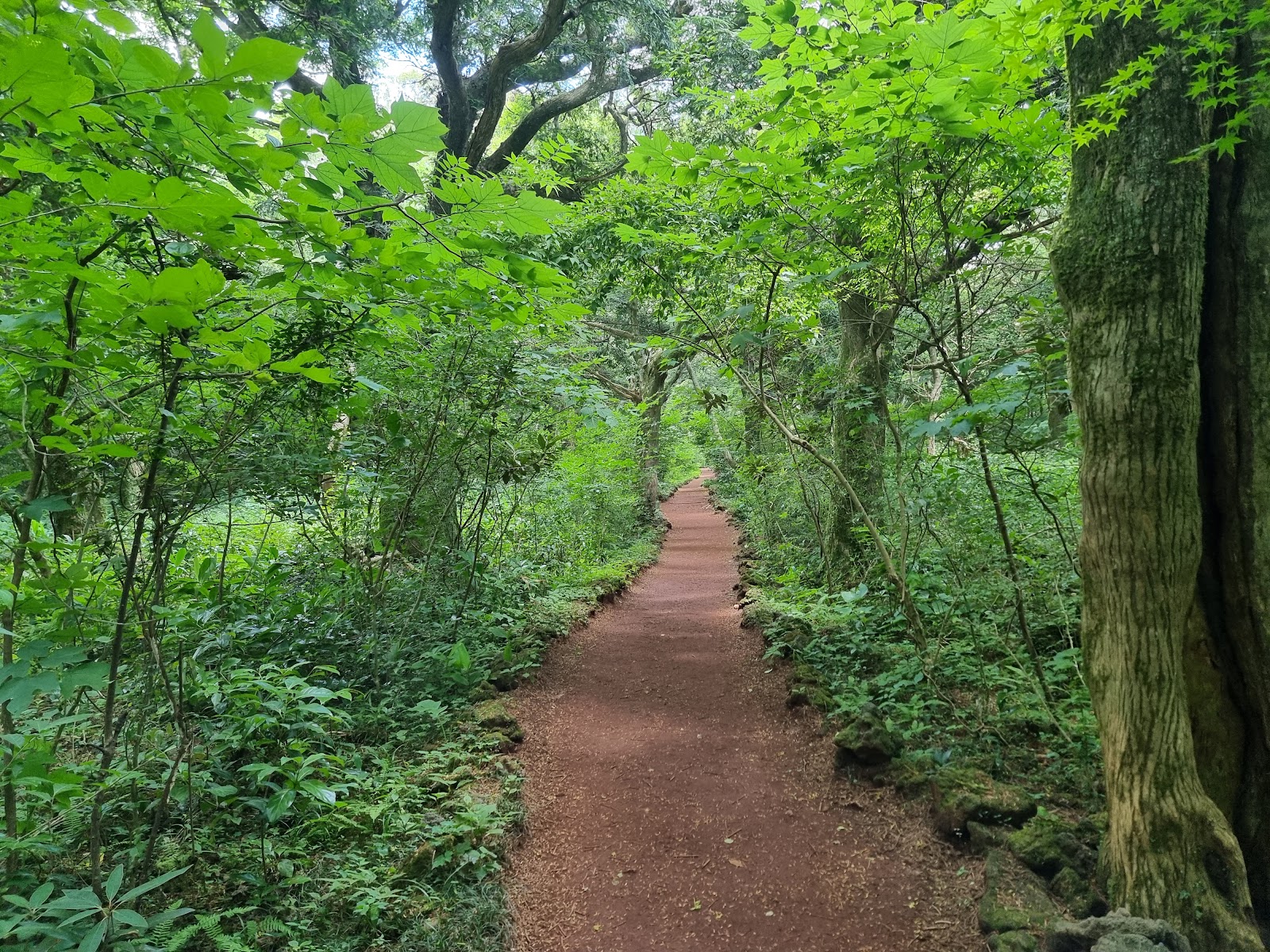
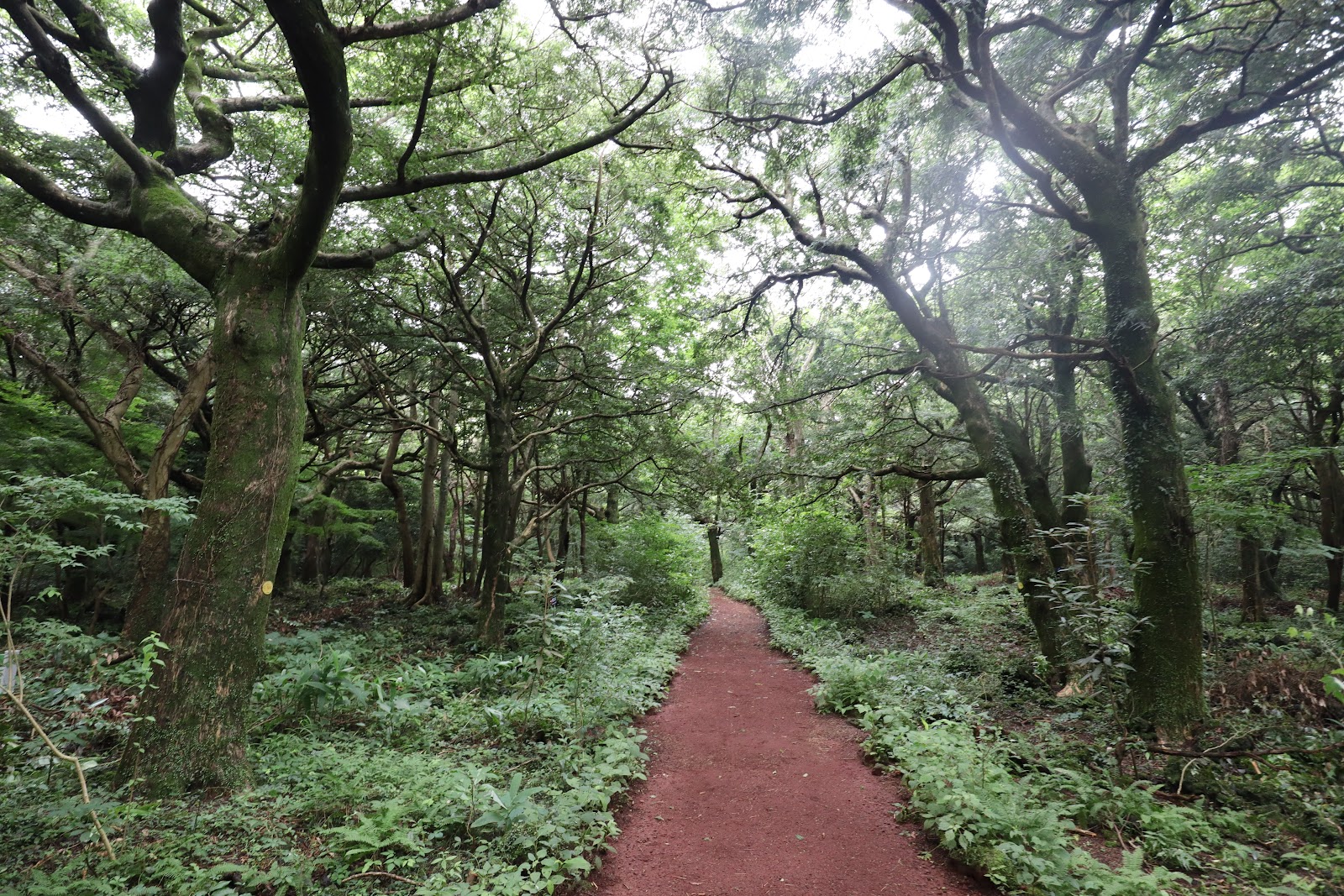
The trail is flat from start to finish and mostly covered in crunchy red volcanic gravel, which Jeju people call songi. There are signposts at the junctions, so it’s hard to get lost. These are the places worth slowing down for.
Walk it slowly
At first, one stretch of nutmeg forest looks a lot like the next. The answer is to stop on purpose. Every few minutes, pick a tree and give it a full minute: first the way its limbs twist, then the rows of needles. Koreans call this kind of slow forest walk sallimyok (산림욕), forest bathing, and Bijarim is one of the best-known places for it.
The love tree
Two nutmeg trees grew so close that their trunks joined into a single tree. Koreans call a pair like this yeollimok (연리목) and see it as a symbol of a couple who stay together for life. If you’re traveling as a couple, you already know where your photo is getting taken.
The millennium tree
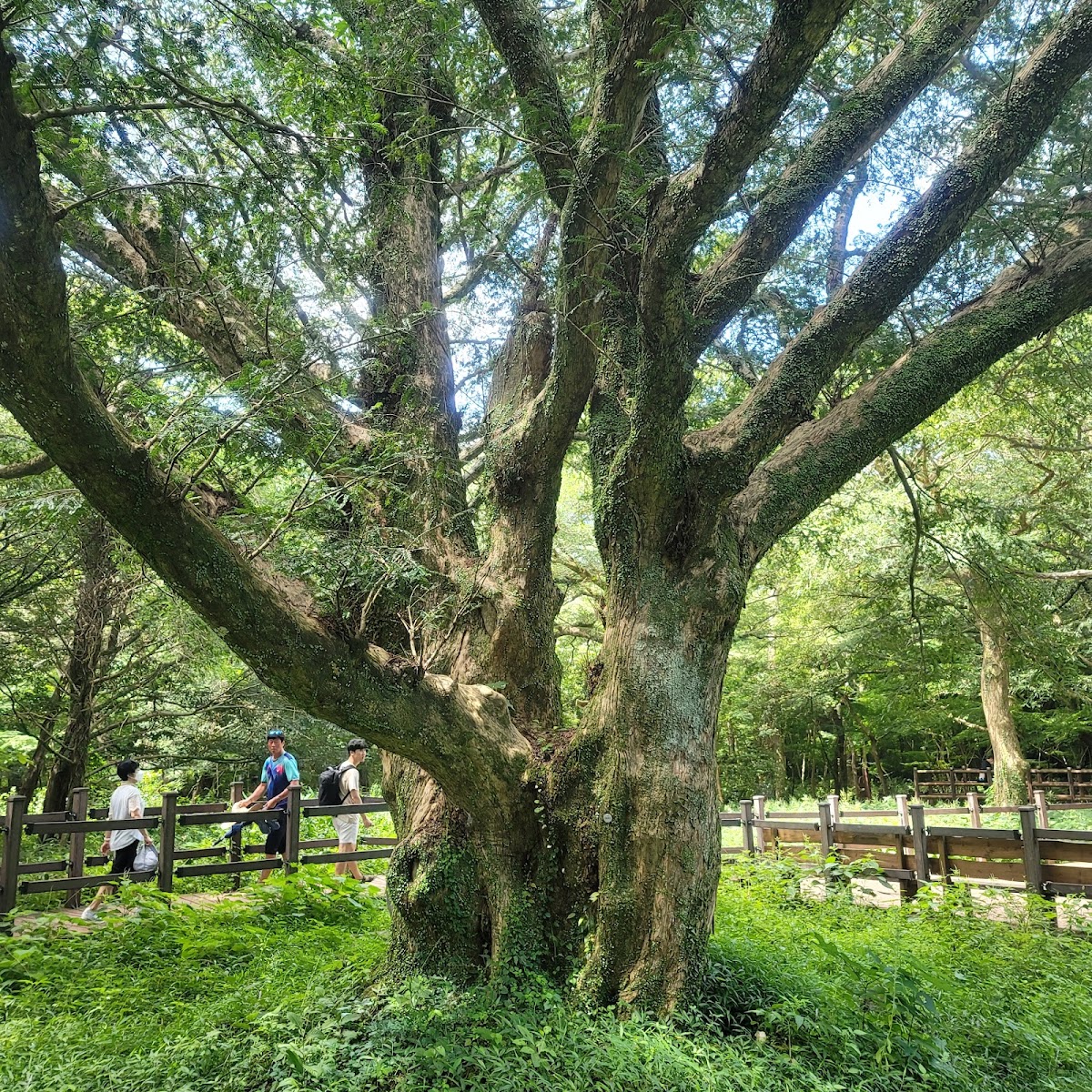
The most famous tree here is labeled 새천년비자나무 on the Korean signs, which translates as New Millennium Nutmeg Tree. It’s the big old tree of the forest and the one to save time for. Stand well back first to see the whole crown, then walk around it as far as the path allows.
The name doesn’t tell you its age. The trees here are 500 to 800 years old, and this one is at the old end of that range. Nothing in the forest is a thousand years old.
Birds and wildflowers
Native birds live all through the forest, and on a still morning you’ll hear several before you see one. When there’s a gap between groups of walkers, they’re most of what you hear. Native plants and wildflowers grow along the way, and the whole place is clean and well looked after.
The photo to take
The shot to look for is the red path curving away between dark trunks. Crouch low and wait for a gap between walkers so the path leads into the trees. For the biggest trunks, switch your phone to its wide lens. A normal shot from the trail rarely fits them.
The shoe blower
On the way out there’s an air blower for cleaning your shoes. It looks like a gimmick. Use it anyway. The red gravel dust gets into every seam, and thirty seconds with the air hose keeps it off your rental car’s floor mats.
If you only have an hour
Follow the signs to the love tree and the millennium tree, give each a few minutes, and keep moving in between. You’ll be done in about an hour. A second hour lets you walk slowly and take time for the birds and the branches.
⏰ When to Go
Opening time is the best time. Arrive at 9 AM and you get the forest at its quietest, with the whole afternoon free for the coast. Late afternoon works too, as long as you’re through the gate by four. Weekday mornings are quieter than weekends, when local families come out.
If you can choose your day, save Bijarim for a sunny one. Light rain is fine too. The gravel drains fast and the old trees give some cover, which is why Bijarim keeps showing up on Korean lists of rainy-day spots in Jeju. In heavy rain or with a typhoon warning, call 064-710-7912 before you set out.
Any season works. The nutmegs are evergreen, so the forest is green in January and in July. Autumn brings color from the maples. In summer you’ll be glad of the shade, and of insect repellent.
🚗 Getting to Bijarim
Bijarim is inland in Gujwa-eup, the northeast corner of Jeju, away from the coastal towns. Driving is the easiest way to get there, and there’s a parking lot at the forest.
Use Naver Map or Kakao Map for directions. Both handle Korean roads and bus routes better than Google Maps. Search 비자림, or enter the address in Korean: 제주시 구좌읍 비자숲길 55.
By bus
Buses do come out here, but rural routes in east Jeju don’t run often. Look up the current routes in Naver Map or Kakao Map the night before. Even more important, check the times of buses back before you start walking, so you can finish in time to catch one.
By taxi
You can call a taxi with the Kakao T app. Out here among fields and forest, a car can take a while to reach you, so request one as you finish the walk, while you’re still at the shoe blower.
🗺️ Building a Day Around It
A morning plan that works:
- 9:00 Arrive as the gate opens and buy tickets.
- 9:10 to 11:00 Walk the trail, with plenty of time at the love tree and the millennium tree.
- 11:00 Shoe blower, toilets, a cold drink.
- 11:15 Head to the coast for lunch.
For an afternoon visit, spend the morning on the coast and get to Bijarim around 2 PM. You’ll be out by 4, two hours before closing.
Either way, the coast is the obvious next stop. Hamdeok Beach is on the same northeast side of the island, and our guide explains which end of the beach stays quiet. Woljeongri Beach is in Gujwa-eup too.
Gujwa is known for its carrots, so if you see carrot juice or carrot cake on a café menu nearby, it’s probably made with the local crop.
Choosing between forests? Bijarim is the shorter walk. Our Saryeoni Forest Trail guide covers the forest people most often compare it with, including when its gate closes.
If your flight is in the afternoon, you can do Bijarim in the morning and then stop briefly at Yongduam Rock. It’s close to the airport and takes about twenty minutes.
👟 What to Wear and Bring
- Closed shoes you don’t mind getting dusty. Mesh sneakers fill up with the red grit.
- Insect repellent from late spring to early autumn.
- An umbrella or a light rain jacket if the weather looks uncertain.
- Binoculars, if you like birds.
- A little patience at the big trees, while another group finishes its photos.
❓ Short Answers
How long does Bijarim Forest take?
One to two hours for the full trail, which is about 2 to 3 km and flat. Plan on the full two if you stop for photos.
How much is the entrance fee?
3,000 won per adult. Ask at the ticket window about prices for children.
What are the opening hours?
9 AM to 6 PM, every day of the week. Arrive by 4 PM if you want to finish without rushing.
Do I need to book?
No. For a regular visit you buy a ticket at the window when you arrive.
Is the walk hard?
No. The trail is flat the whole way, so comfortable closed shoes are all you need.
Is Bijarim good for kids?
Yes. It’s flat, there are toilets on site, and the shoe blower at the end is a good reward for the last stretch.
Can I bring a stroller or wheelchair?
The ground is flat but covered in gravel. Call 064-710-7912 before you go and ask which route is smoothest. If Korean is a problem, your hotel front desk can usually make the call.
Can I get there without a car?
Yes, by bus or by a taxi booked through Kakao T. Check bus routes and times back in Naver Map or Kakao Map before you start walking.
Is it worth going in the rain?
In light rain, yes. The gravel drains quickly and the trees give some shelter. In heavy rain or a storm, call ahead before driving out.
How do you pronounce Bijarim?
BEE-jah-rim. Showing a driver 비자림 on your phone works just as well.
📌 Quick Recap
- Thousands of nutmeg trees, 500 to 800 years old, inland in Gujwa-eup on Jeju’s northeast side.
- 3,000 won per adult, open daily 9 AM to 6 PM, tickets bought on arrival.
- Flat trail of about 2 to 3 km. Allow one to two hours.
- Find the love tree and the New Millennium Nutmeg Tree, then use the shoe blower on the way out.
- Go at 9 AM for quiet, or arrive by 4 PM at the latest.
- Driving is easiest. If you take the bus, check the times back in Naver Map or Kakao Map before you walk in.