Donggung Palace and Wolji Pond sits at 102 Wonhwa-ro in Gyeongju, about two hours north of Busan, and it is open every day from 9:00 AM to 10:00 PM. Recent visitors report entry at around 3,000 won per person. No reservation. The whole loop takes half an hour at a normal pace. That combination is the entire reason the place works as a side trip: it is cheap, it is quick, and it is one of the few historic sites in Korea that stays lit and open long after dinner.
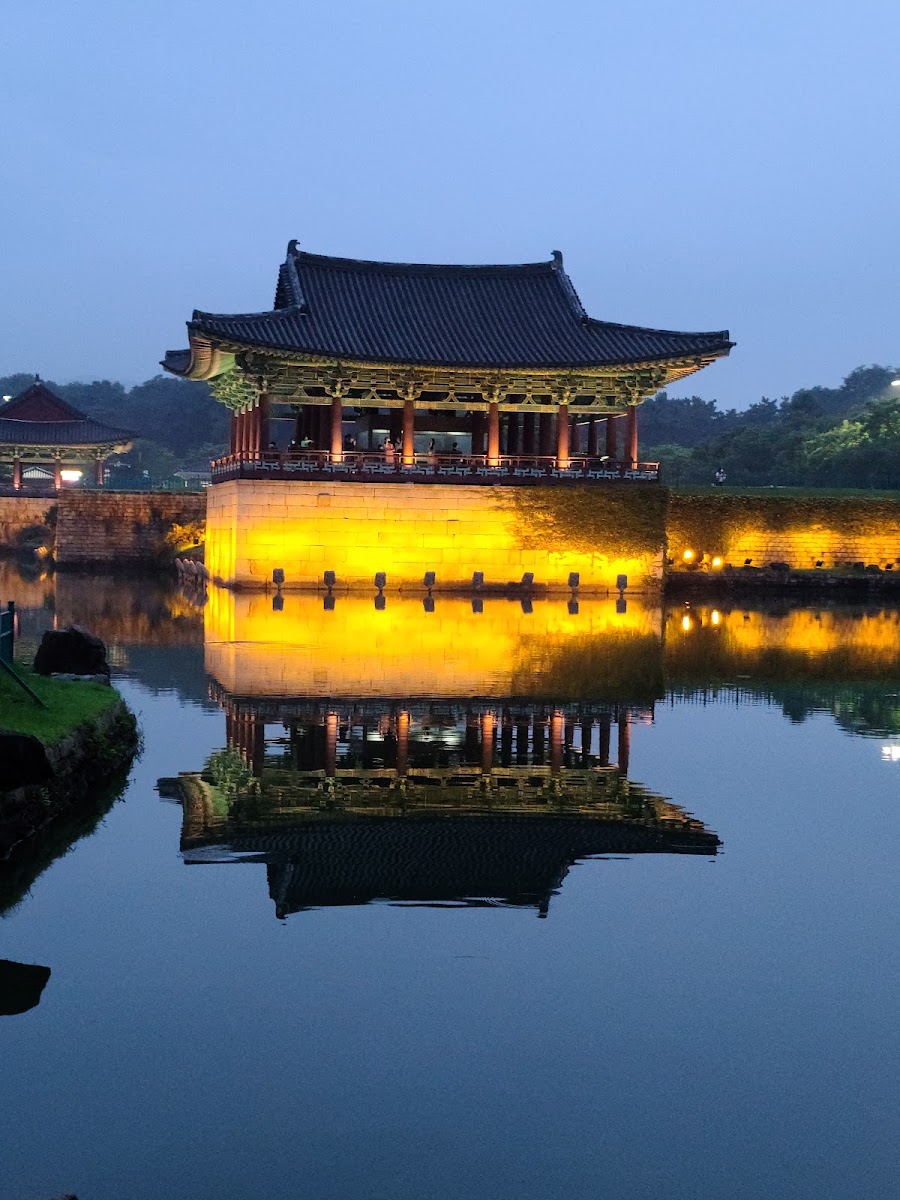
Go at dusk. Not after dark, not in the flat middle of the afternoon. The site rewards people who are standing by the water when the floodlights come up and the sky still has colour in it, because that is the fifteen-minute window where the reflection in the pond has both the gold of the lamps and the blue of the sky in it. Arrive an hour before sunset, walk the grounds while it is still bright, then claim your spot. People who show up at 9 PM see the same buildings against black.
🏯 What Donggung Wolji Pond in Gyeongju actually is
This was the secondary palace of Silla, the kingdom that ran most of the Korean peninsula from Gyeongju for the better part of a thousand years. The pond was dug around 674 CE, with three small islands set into it. Banquets happened here. Foreign envoys were received here. Then the kingdom ended, the buildings went, and for centuries the site was a marshy field that locals called Anapji, the pond of geese and ducks.
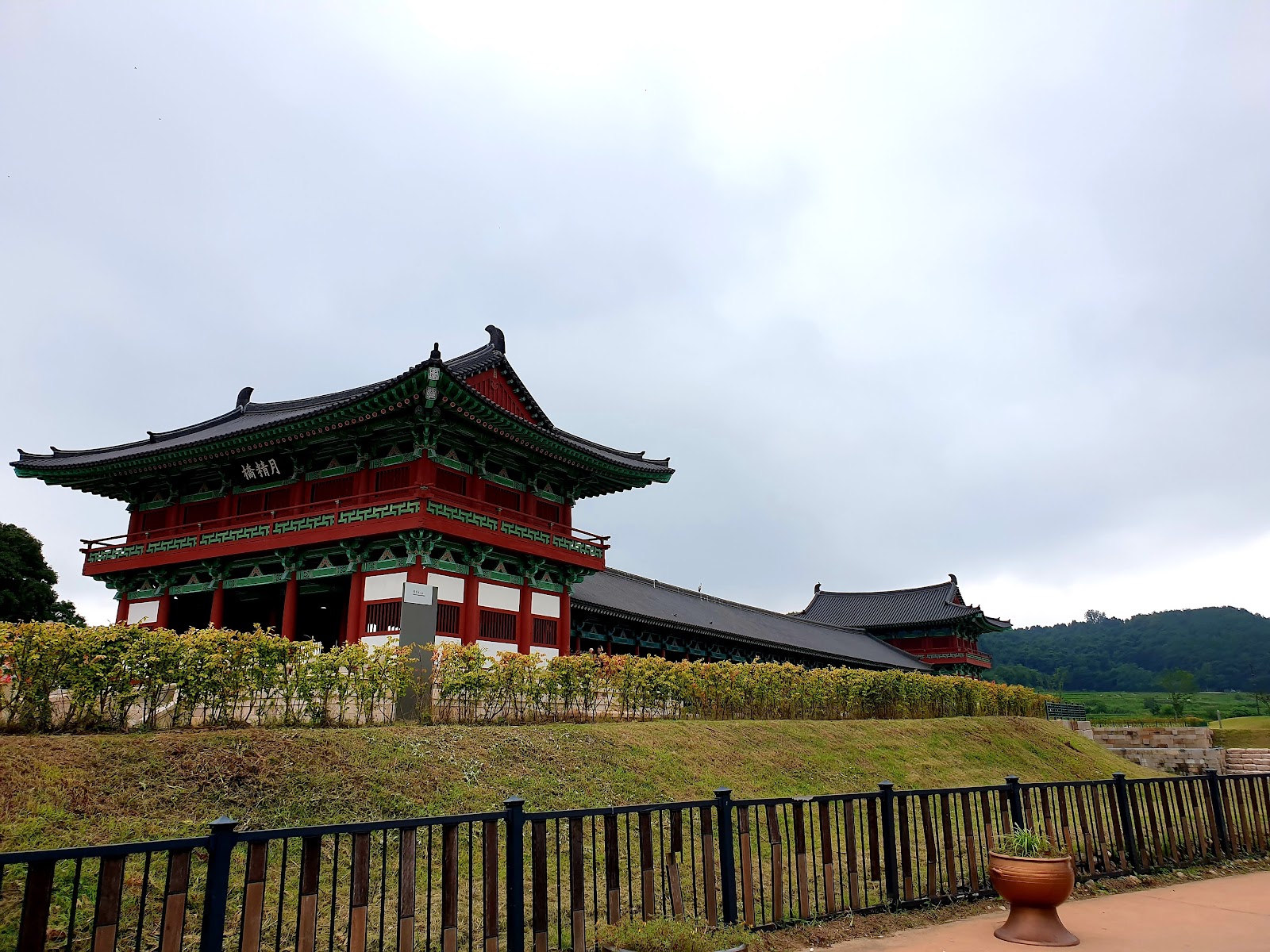
What you walk around today is a pond, a landscaped garden, and three reconstructed pavilions raised on stone platforms. Three buildings. That number matters more than anything else in this article, because the word “palace” sets an expectation that the site does not meet, and a steady trickle of disappointed reviews comes from people who pictured Gyeongbokgung in Seoul and got a garden with three halls.
Set the expectation correctly and it lands. Three lit pavilions, a black pond doubling them, and a path that loops you past the reflection from four different angles in under half an hour.
The rating tells you the same story from the other side. 4.5 stars across more than 20,000 reviews is a very high score for a site this small. People who come for the reflection leave happy. People who come for a palace complex leave writing three-star reviews that begin with the word “beautiful” and then explain what they thought they were getting.
🌇 The hour that decides your visit
Check the sunset time for your specific date before you leave your accommodation, because Gyeongju in June and Gyeongju in December are two different trips. Summer sunsets run late enough that you will be eating dinner first and arriving around 8. Winter sunsets come early enough that the gate opens onto an already-dark garden by half past five.
Here is the sequence that works, whatever month you are in.
- Sunset minus 60 minutes. Enter. Walk the full loop clockwise in daylight. You will see the excavated foundations and the garden planting, which vanish completely once the lamps take over.
- Sunset minus 20. Pick your spot on the far side of the water, where the rocks edge the path and the three pavilions line up across the pond.
- Sunset to sunset plus 30. Stand still. This is the photograph. The lamps are on, the sky is still readable, and the water holds both.
- After that. Do a second, faster loop and leave. The site stays open to 10 PM, so there is no rush at the exit, but the light stops changing.
One warning about the crowd. On weekends and through the summer the path around the pond gets genuinely packed, and the best viewing points are shoulder to shoulder with people holding phones above their heads. If you hate that, a Tuesday in March is a completely different place. If you cannot avoid a Saturday, arriving early is what buys you a spot rather than a view of the back of someone’s head.
🪷 What to look for while you are in there
The pond was engineered so that no single viewpoint shows you the whole of it. The shoreline curves, the three islets interrupt the sightlines, and the result is a body of water that reads as larger than it is. Walk the loop and notice how the far bank keeps hiding itself. That was deliberate, in the seventh century, and it still works.
In summer the pond fills with lotus. That changes the photograph substantially: broad leaves across the water instead of a clean mirror, and much less reflection. Both versions are worth seeing. Just know which one you are signing up for, because the glassy reflection shots that made this place famous online are mostly shot outside lotus season.
The three reconstructed halls are lit from below and from the eaves. Look at the underside of the roof structure from close range before you cross to the far bank. The bracketing is the part that the long-distance photographs flatten into a silhouette, and the lighting picks it out clearly if you are standing within a few metres.
🚄 Getting there from Busan
Two realistic routes, and they suit different travellers.
- KTX to Singyeongju. Fastest, and the trains run frequently from Busan Station. The catch is that Singyeongju station sits well outside the old centre, so you land and then need a bus or taxi to reach the historic district. Check the live timetable at letskorail.com before committing to a return time.
- Intercity bus from Nopo. Slower, cheaper, and it drops you much closer to where you actually want to be. Nopo is on Busan Metro Line 1 at the northern end, so it is a straightforward ride from anywhere on that line.
Whichever you choose, the return journey is the part that catches people out. You are leaving a site that stays open to 10 PM, in a city an hour and a half from your hotel, and the last train and the last bus do not wait. Photograph the departure board when you arrive, or screenshot the timetable. Do it before you go to the pond, not after.
If you are still working out the rail side of a Korea trip, the mechanics of booking, seat classes and platform-finding are covered in Seoul to Busan by KTX: The Part Nobody Explains, and most of it transfers directly to the Busan to Singyeongju leg.
💳 Tickets, money and the things nobody mentions
You buy at the gate. No reservation is needed, no timed entry, no app. Visitors consistently report the fee at around 3,000 won a head, which is low enough that it is not worth planning around. Card payment is normal at Korean ticket offices, but carrying a small amount of cash for a site like this removes one possible problem.
The site phone number is 054-750-8655 if you need to confirm anything on the day, such as a seasonal closure or an event.
- Shoes. The loop is flat and paved, but you will be standing still on stone for twenty minutes in the cold. Dress for standing, not for walking.
- Tripods. Small ones are fine in principle, but on a busy night there is nowhere to put one without blocking the path. A rail or a rock works better.
- Phone cameras. Night mode handles this scene well. Brace against the railing and give it the full exposure time rather than hand-holding it.
- Time budget. Thirty minutes covers the whole thing comfortably. Sixty if you want the daylight loop and the lit loop.
📸 Where to actually stand
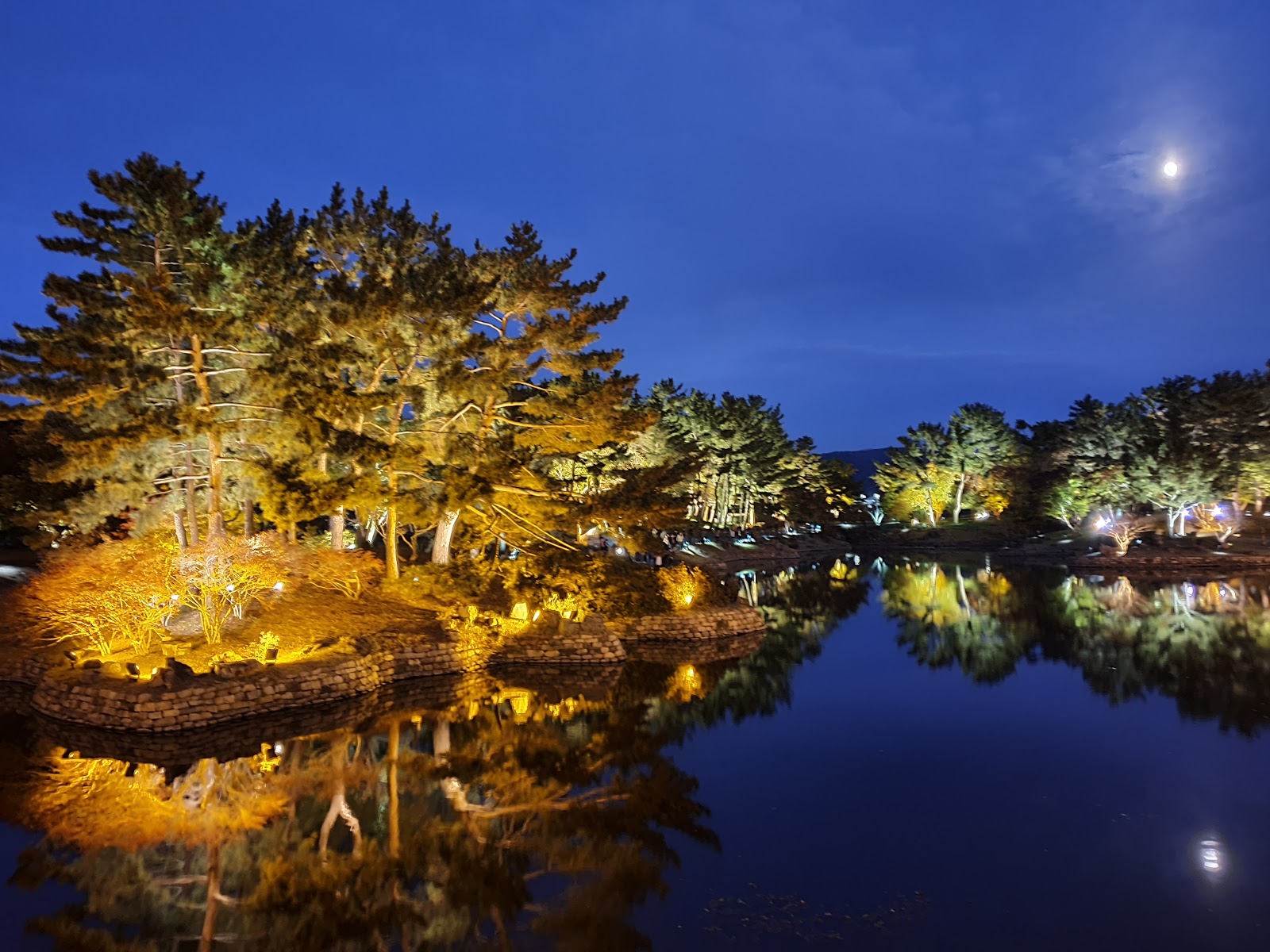
The classic frame is taken from the bank opposite the main pavilions, where the path runs close to the water and low rocks break the edge. From there all three halls sit in a row with their reflections beneath them, and the rocks give the foreground something to hold. That stretch is where the crowd concentrates, and it is where arriving twenty minutes early pays for itself.
Two alternatives when that bank is full. First, shoot a single pavilion instead of all three, from closer in, using the water as a dark base rather than a mirror. Second, walk on past the crowd and shoot back along the shoreline at an angle, which gives you the lamps receding into the dark and far fewer heads in the frame.
Wind flattens the reflection, and a still night doubles everything perfectly. You cannot control that. What you can control is not spending your only calm evening indoors.
🗺️ Fitting it into a Busan trip
Gyeongju works as a full day out of Busan, with the pond as the last stop rather than the first. Spend the daylight hours on the burial mounds and the old town, eat early, then walk in as the light drops. Anything you do after the pond is a bonus, because the pond is the thing that needs a specific hour and everything else does not.
Doing it the other way around, first thing in the morning, is defensible if you dislike crowds and want the excavated foundations in clean daylight. You will see a pleasant garden with three buildings in it. Most people who do that then wish they had come back at night.
If your Korea trip only has room for one lit-up-at-night experience and Gyeongju is a stretch, Busan has its own version of the same evening, and the spots that hold up are listed in Busan After Dark: Where the City Actually Looks Good. For a Silla-adjacent daytime pairing closer to home, Haedong Yonggungsa opens at 4 AM and rewards the opposite end of the clock entirely.
⏱️ The short answers
How long do you need at Donggung and Wolji Pond?
Thirty minutes for the full loop. An hour if you want both daylight and darkness, which is the version worth doing.
Do you need to book?
No. Tickets are sold at the gate and there is no timed entry. Reported cost is around 3,000 won per person.
What time does it close?
10:00 PM, seven days a week. Opening is 9:00 AM. Last entry is usually earlier than closing at Korean sites, so do not plan to walk in at 9:50.
Is it worth going in the daytime?
It is pleasant and quiet. The lighting is what makes the place, so a daytime-only visit sees a much smaller version of it.
Is it in Busan?
No, it is in Gyeongju, roughly two hours away depending on your route. It is a standard day trip for people based in Busan.
Is it good for kids?
The loop is flat, short and stroller-friendly. There is nothing to climb and nothing to do except look, so interest depends entirely on the child.
When is lotus season?
Summer. The pond fills with lotus, which is beautiful and also removes most of the mirror effect. Outside summer you get the clean reflection.
📌 In short
- 102 Wonhwa-ro, Gyeongju. Open 9:00 AM to 10:00 PM daily. Phone 054-750-8655.
- Around 3,000 won per person by recent visitor reports. No booking, buy at the gate.
- Pond dug around 674 CE with three islets. Three reconstructed halls, not a full palace complex.
- Arrive an hour before sunset. The reflection window is roughly sunset to sunset plus thirty minutes.
- Thirty minutes covers the loop. Sixty if you want it in both daylight and lamplight.
- Summer means lotus leaves and less reflection. Other seasons mean a clean mirror.
- Weekends and summer evenings are crowded at the best viewpoint. Early arrival buys the spot.
- From Busan: KTX to Singyeongju plus onward transport, or the intercity bus from Nopo. Screenshot the last departure before you go to the pond.