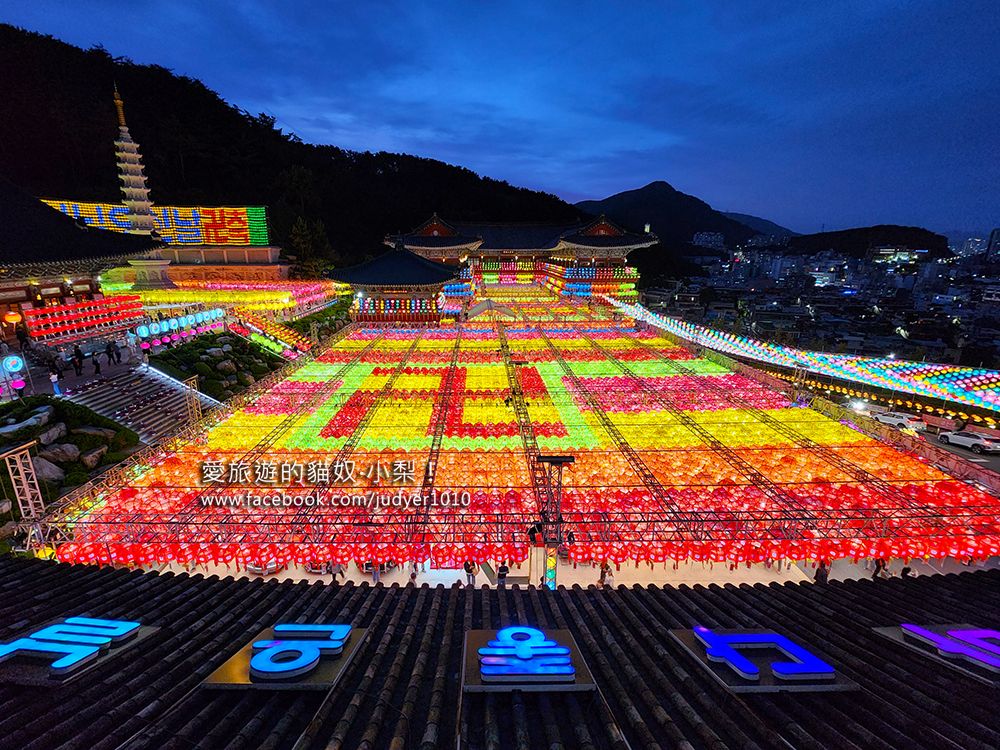
The Samgwangsa Busan lantern festival happens once a year, around Buddha’s Birthday, when the temple courtyard disappears under thousands of paper lanterns strung wall to wall. They switch on at 7 PM. If you show up at 7 PM, you will spend the lighting stuck in a bus queue at Seomyeon.
That single sentence is most of the advice. Samgwangsa sits on a hillside above Seomyeon in Busanjin District, twenty-odd minutes from the middle of the city on a normal day, and considerably longer on the one night everybody in Busan wants to go up the same road. Arrive at 5:30. Kill the hour. Watch it come on.
The rest of the year Samgwangsa is a large, quiet, largely empty mountain temple that stays open 24 hours and asks nothing of you. Both versions are worth a morning. They are completely different experiences, and this guide covers both, because you probably aren’t in Busan during the lunar fourth month.
🏮 What the Samgwangsa Busan lantern festival actually is
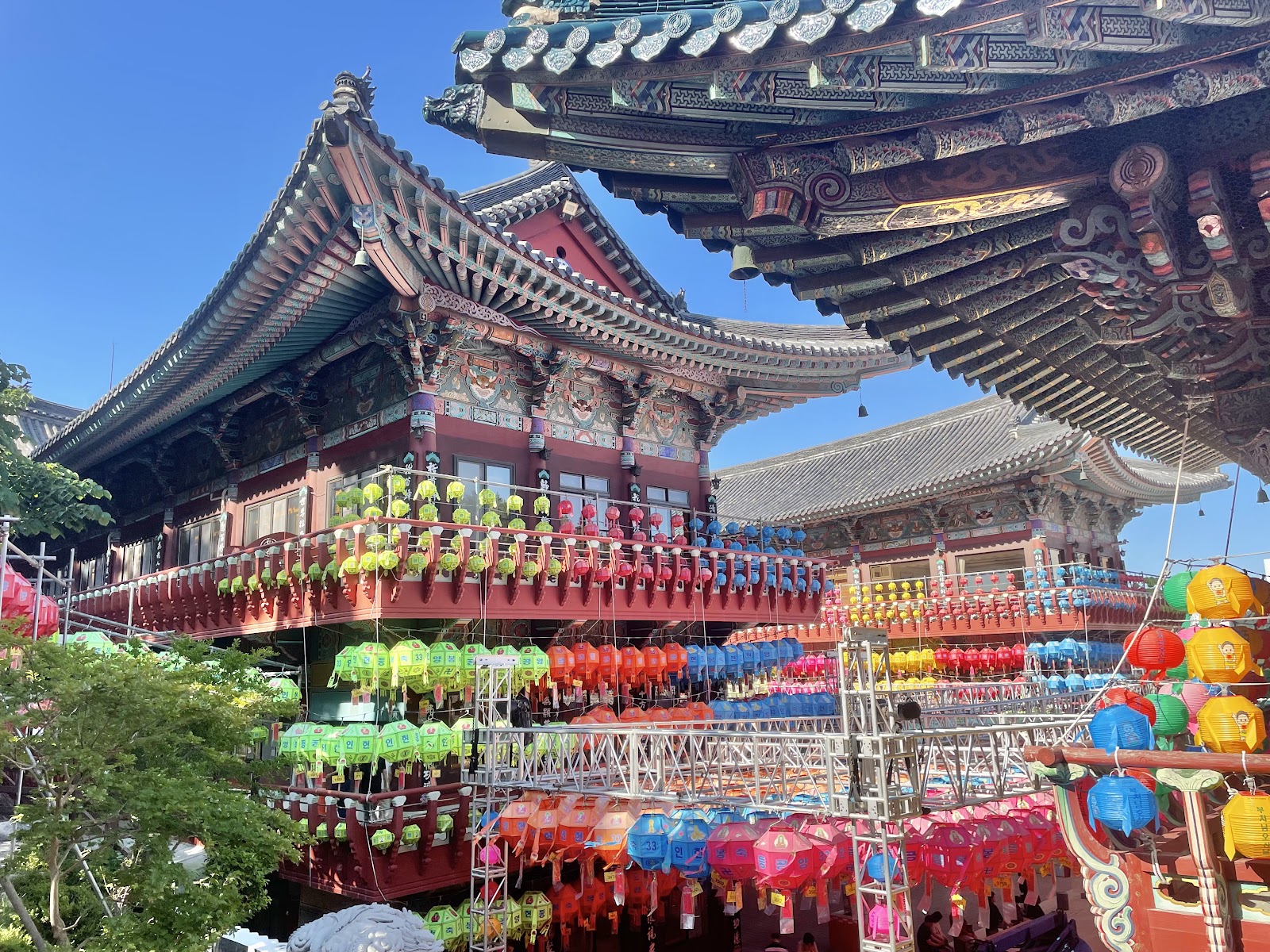
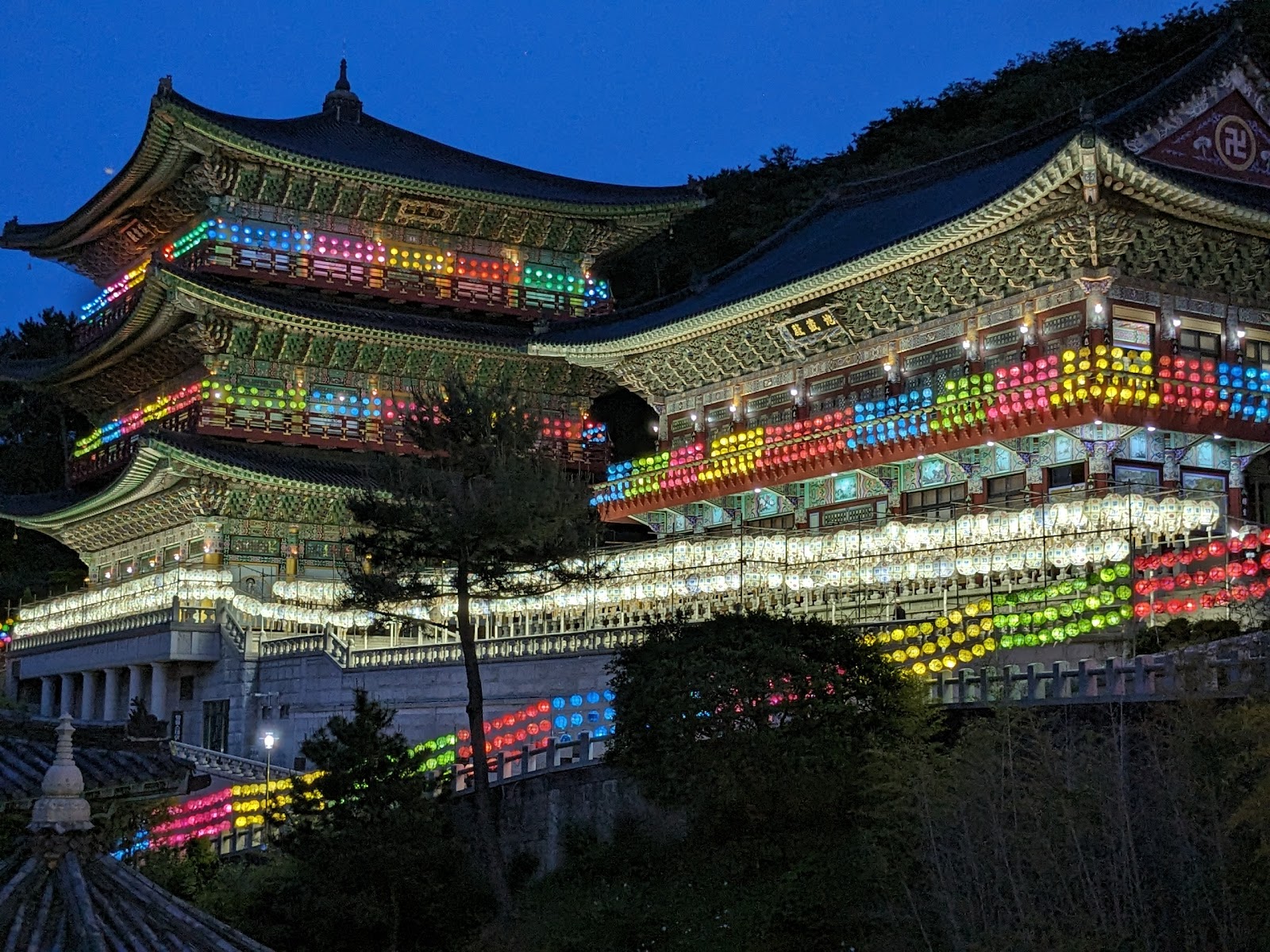
Every Korean temple hangs lanterns for Buddha’s Birthday. Samgwangsa hangs them at a scale that makes people stop walking. Visitors who have tried to estimate the count land somewhere near ten thousand, strung in dense overlapping rows across the whole open plaza in front of the main hall, so the sky above you turns into a low ceiling of pink, yellow, blue and white.
Each lantern carries a paper tag. Families buy them and write names on them, for health, for exams, for the dead. That is what you are standing under. It reads differently once you know.
The temple holds a 4.6 rating across roughly 1,600 Google reviews, and a large share of the five-star ones are people describing this exact night. Even reviewers who have seen a lot of Korean temples put this one near the top of their list.
🗓️ When it happens, and why you can’t just Google last year’s date
Buddha’s Birthday falls on the eighth day of the fourth lunar month, so the Gregorian date moves every year. In 2026 it landed on 24 May. In other years it has fallen in early May. There is no fixed weekend to plan around.
The lanterns are not put up on the morning of and taken down that night. They go up ahead of the day and stay for a stretch either side of it, which means the evenings before the holiday itself are lit and dramatically less crowded. If your dates are flexible by even three days, aim for a weekday evening in that window rather than the holiday proper.
Before you lock in flights around it, confirm the year’s date and the temple’s event window through Visit Busan, the city’s official tourism site.
🚌 Getting there, and the part that goes wrong
Samgwangsa is uphill. Not gently uphill. The temple sits above a residential slope, and the last stretch is steep enough that “just walk it” is a real decision rather than a formality.
The bus that goes all the way up
Bus Busanjin-gu 15 (부산진구15) runs from near Lotte Department Store in Seomyeon up to the front of the temple. It is a small neighbourhood bus. On a normal day this is the clean answer: get to Seomyeon on the subway, find the stop by Lotte, ride up, walk in.
On festival night, that same bus is the problem
Visitors on the 2026 holiday reported a long queue for that bus at Seomyeon station, a taxi that crawled through jammed traffic, and then the final road up closed to private cars anyway. If you have booked a taxi to the temple gate on Buddha’s Birthday, expect it to end somewhere short of the gate.
What worked instead: take any bus heading in the temple’s direction, get off lower down, walk, and pick up the free shuttle the temple runs on the busy evening for the final climb. Look for it once you’re on the hill road rather than trying to find it from the city centre.
If you are on a tight schedule and only have one evening, treat the last kilometre as walking. Then any transport that shows up is a bonus instead of a plan collapsing.
Getting a transit card sorted before any of this saves real friction, especially on a night when you may switch buses twice. If you haven’t yet, start with the card, not the app.
⏱️ A timing plan that survives contact with the crowd
This is built from what people who went on the holiday actually did, including the bits they’d change.
| Time | Where you should be |
|---|---|
| 16:30 | Leaving Seomyeon. Yes, this early. |
| 17:30 | Inside the temple grounds, still full daylight |
| 17:30–18:30 | Walk the halls, find the phoenixes, sit down |
| 18:30 | Take your standing spot in the main plaza |
| 19:00 | Lanterns on |
| 19:00–20:00 | Photos, then move to the upper terraces |
| 20:00+ | Start down before the whole crowd does |
The 90 minutes between arrival and lighting look like dead time on paper. They are the reason the evening works. You get the temple in daylight, you get a spot without shoving, and you are not one of the people arriving at 18:55 discovering the plaza is already full.
🍵 What to do with that hour
The temple hands things out. Visitors on the holiday were pointed toward volunteers giving away soy milk and cake, free, no ceremony about it. Staff will often tell you where to go if you look like you’re waiting for something.
There is also a table where you can make a paper lotus flower. It looks like a children’s activity. It is a children’s activity. It also eats twenty-five minutes very pleasantly and you leave with something in your hand, which is more than most festival queues give you.
- Bring a thin layer. The hill gets cold after sunset even in May.
- Eat before you go up. The free snacks are a snack, not dinner.
- Shoes you can climb stone steps in, in the dark, in a crowd.
- Phone charged. You will take more photos than you expect.
👀 Things people miss while looking up
Once the lanterns are lit, everyone’s head tilts back and stays there. Fair enough. But the building work at Samgwangsa is unusually good, and it’s all at eye level or above the doorframe.
Look for the two golden phoenixes. Reviewers who spot them tend to call them their favourite thing in the whole complex, and they are easy to walk straight past. Find them before dark, when you can actually see the detail on them.
Then get height. The plaza shot is the postcard, but the terraces and stairs above it give you the lanterns as a solid field of colour with Busan spread out behind. That is the frame people remember. It’s also where the crowd is thinnest.
🌤️ Going on an ordinary day, which is most days
Samgwangsa is listed as open 24 hours, every day. No ticket booth, no time slot. On a regular weekday morning you may share the place with a dozen people.
Budget realistically: about 10 minutes of climbing from the elementary school at the bottom of the slope, then roughly 40 minutes to walk the grounds properly. Call it an hour and a half door to door from Seomyeon and you’ll be comfortable.
Mornings sometimes bring a monk sounding a horn from near the main hall, around ten. Don’t plan around it. If it happens while you’re there, stop walking and listen, because it carries down the whole valley.
If you’re building a temple day, Samgwangsa and Haedong Yonggungsa on the coast are the two big ones, and they are opposites: one is mountain and enclosed, the other is sea and exposed. Doing both in one day means crossing the entire city, so pick a morning for one and give the other its own slot.
⛰️ If you want the mountain version: Geumjeongsan
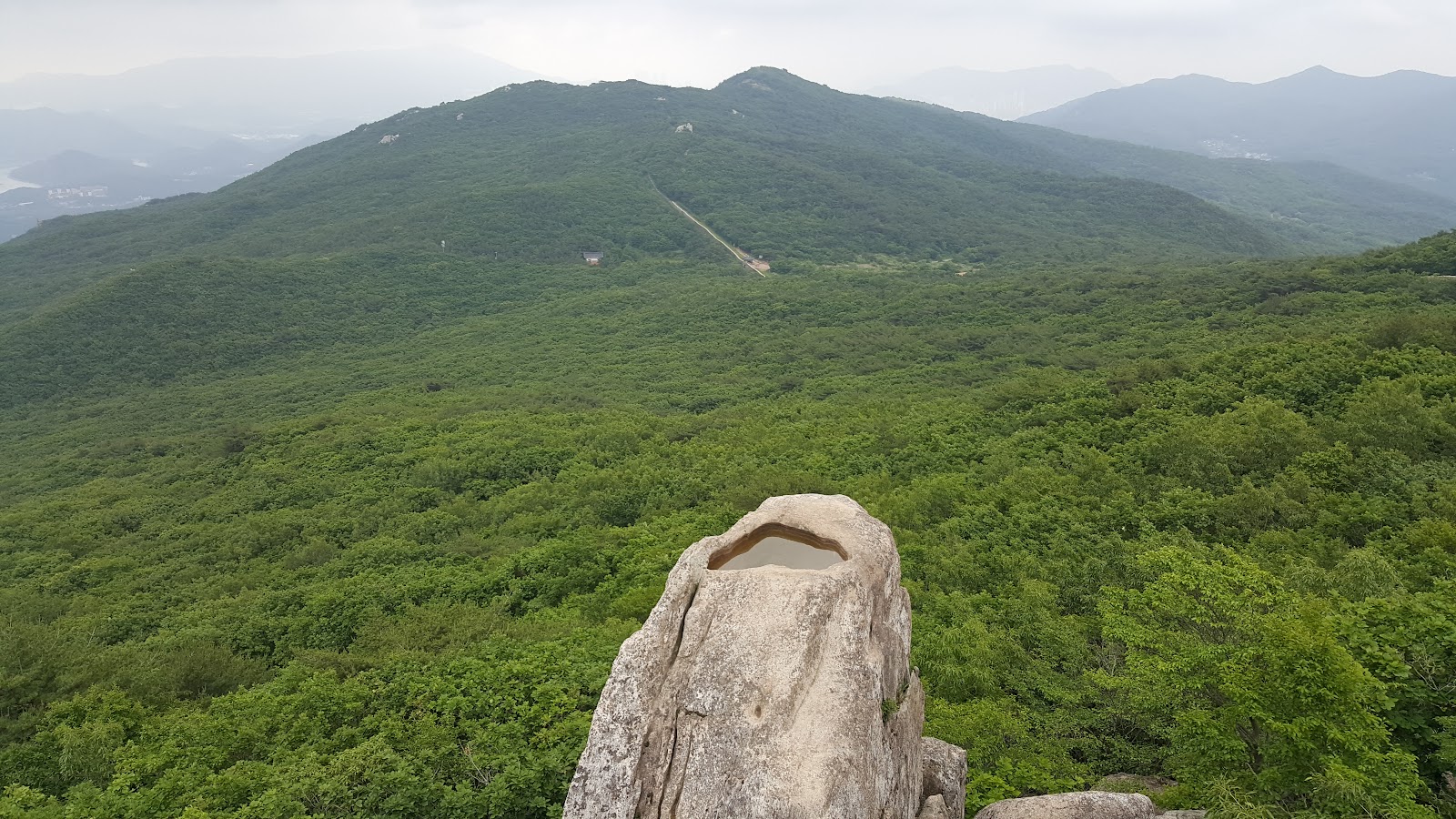
Visitors often pair Samgwangsa with a hill walk. Geumjeongsan, further north in the city, is Busan’s proper mountain: 4.6 across around 120 reviews, and the reviews are all about the view.
The short version is the 0.8 km track from the North Gate to the peak. Well marked, steep in places, steps in others. Hikers describe it as short enough to do on a whim and steep enough to feel it. From the top you get the city laid out below, Gwangan Bridge included.
Two warnings from people who’ve done it. The wider mountain is enormous, and anyone talking about trekking it properly is talking about two days, not an afternoon. And in winter the trail ices over, so the 0.8 km becomes a genuine grip problem in the wrong shoes.
For a sunset that needs no hiking at all, the city’s easier vantage points are covered in where Busan actually looks good after dark.
🙏 How to behave, briefly
Samgwangsa is a working temple with people praying in it, on the festival night more than ever. Reviewers who loved the place still felt the need to say this, so it clearly gets ignored.
- Shoes off before entering a hall. There’s a rack.
- Don’t photograph people mid-bow. Lanterns yes, worshippers no.
- Walk around the edges of a hall, not through the middle.
- Voices down inside. Outside in the plaza, normal is fine.
- Shoulders and knees covered is the safe default.
📋 The details on one screen
| Address | 77 Choeupcheon-ro 43beon-gil, Busanjin District, Busan |
| Phone | 051-808-7111 |
| Hours | Open 24 hours, Monday to Sunday |
| Rating | 4.6 from about 1,599 reviews |
| Bus | Busanjin-gu 15 (부산진구15) from near Lotte Department Store, Seomyeon |
| Map search | 삼광사 (Samgwangsa) |
| Reservation | Not required, including on festival night |
💬 Short answers
Is the Samgwangsa lantern festival free?
There is no admission booth. Buying a lantern with your name on it is a donation and entirely optional.
What time do the lanterns turn on?
7 PM on the main evening. Be on the grounds by 5:30 if you want a spot and a calm approach.
Can I take a taxi straight to the temple?
On a normal day, yes. On Buddha’s Birthday the upper road closes to private cars and traffic below it stalls, so plan on walking part of it and using the free shuttle.
How long do I need at Samgwangsa?
About 40 minutes to see the grounds on a quiet day, plus roughly 10 minutes climbing from the bottom of the hill. On festival night, allow three hours end to end.
Is it worth visiting outside the festival?
Yes, for different reasons. Empty halls, mountain air, the phoenixes without a crowd in front of them, and it’s close enough to Seomyeon to fit into a half day.
Can I go at night on a normal day?
The grounds are listed as open 24 hours. The bus up is not, so check the last departure before you commit to an evening visit.
✅ The whole thing in eight lines
- Lanterns light at 7 PM. Arrive 5:30.
- Date moves yearly with the lunar calendar. 2026 was 24 May. Confirm before booking.
- Evenings a few days before the holiday are lit and far quieter.
- Bus Busanjin-gu 15 from Seomyeon on normal days; expect to walk plus shuttle on the holiday.
- Free soy milk, cake and paper lotus making fill the wait.
- Find the two golden phoenixes in daylight.
- Climb to the upper terraces for the better photo.
- Open 24 hours year round, and lovely on an empty Tuesday morning.